
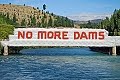
POWER Struggle
Saturday 30 October 2010
The Press
Wild river, a raft, a safety briefing.
Glenn Murdoch, our good natured and we hope responsible guide, goes through the drill. Forward paddle, backward paddle, hold, stop. Drambuie for everyone if you lose your paddle.
Then he gives us the worst-case scenario. This is when the raft capsizes with the crew in the river and not necessarily attached to the boat.
"Keep your legs in front of you and your head looking down the river," he instructs.
The chances of tipping our bulky craft seem remote to a rookie like me but Murdoch, I guess, has to go through the motions like a flight attendant giving a spiel about the aircraft crashing.
We are on the Mokihinui River, which is in a remote northern corner of the West Coast, about 40 kilometres north of Westport. The launching point for our expedition is well inland, just below the fork in the river where the North and South branches meet and just above the 16km Mokihinui Gorge.
If state-owned Meridian Energy wins the day, most of the gorge will flooded up to an 85-metre dam to be built about 15km from the river's mouth. The resulting 14km-long lake will inundate 225 hectares of pristine lowland forest and obviously the stretch of wild river we hope to travel.
Meridian has the project on first base by obtaining the required resource consents from the West Coast Regional and Buller District councils. In March, commissioners decided, two to one, to grant the consents. The Department of Conservation (DOC), Forest & Bird and Whitewater NZ are appealing and the Environment Court is expected to hear the case in 2012.
Forest & Bird field officer Debs Martin, who is sharing a raft with Green Party co-leader Russel Norman (among others), explains Meridian faces another difficult hurdle: for the dam to go ahead, Meridian needs either permission from DOC to flood the land or it needs to acquire the DOC land by swapping it for other land which will provide a net benefit to conservation. Meridian has offered 700ha of land, two blocks of which are in the Mokihinui catchment below the dam.
DOC has completed its evaluation and a draft report recommends a firm "no" to Meridian on all counts. The final decision must be made by the conservation minister.
Martin hopes the area will end up in a conservation park, a process that was "on the table" before Meridian began the consent process.
She accepts the minister could direct the department to withdraw but thinks that unlikely because DOC has thrown "unprecedented" resources at the fight.
It all looks very difficult for Meridian but its Mokihinui project manager, Chris Evans (not on the trip), who has worked on the project for four years, says Meridian will persevere, concentrating for the moment on the appeal. Meridian has withdrawn its DOC flooding application so it can enter more open discussions.
The search for land to satisfy DOC continues, he says: "It's not an easy task when DOC already administers 80 per cent of land on the West Coast."
Back at the river, the launch is getting closer. About 120 people have gathered for a 6.30am start on a dull but mercifully dry morning.
Evidence before the commissioners showed only about 300 people use the area each year. We are certainly going to boost the average.
The event has been organised by the Christchurch White Water Canoe Club, more as a statement than a protest. The assemblage has its fair share of greenies but white water people come in all sorts of political stripes. Norman is the only politician on the trip.
The first step is for the rafts and kayaks to be bundled into nets and slung beneath helicopters for the trip up to the forks. One whitebaiter has set his net in the river just below the very site where the gear and people are loaded. In a scene reminiscent of Apocalypse Now, three helicopters flying neatly behind each other descend in an urgent racket of whining rotors.
The white water people are obviously not keen on the power project. The proposed lake does not stop them using the higher and difficult North Branch of the river but it means they face a dull 14km flat paddle on the descent which is currently broken by numerous boulder- strewn rapids, quieter stretches of green water, sandy beaches, striking rock features and healthy bush.
They concede their kayaks and rafts are not often seen on the river. As the day of our adventure shows, getting kayaks and rafts up the river is a major and expensive exercise.
Although the commissioners saw the loss of white water recreation as a "significant effect" they considered the dam would provide "a more diverse range of opportunities to a much wider group of people".
Hugh Canard, a Christchurch economic development and tourism consultant, whose heroic organisational abilities make the Mokihinui statement such a success, doesn't buy that argument.
He likens his white water colleagues to the endangered blue ducks who will be supplanted by the dam lake.
"We have the same rights as anybody else. Numbers shouldn't come into it. We are saying we are the blue ducks who have been using the river and minding their own business. Then along comes whoever and wants to take it away. You're going to displace blue ducks and introduce mallards."
While a lake would no doubt increase patronage of the area, by that logic a gondola up Aoraki/Mt Cook would be fine because it would do the same thing for the mountain, he says.
In his view the commissioners overlooked that the Mokihinui is one of only three reasonably accessible rivers on the West Coast that can be used by the majority of competent kayakers.
People who want a lake experience on the coast are spoiled for choice with about 100 naturally formed lakes that are under-utilised, he says.
Canard, 68, who has been kayaking since his late 30s, worries the lake will end up like Lake Dunstan at the head of the Clutha Dam - "dead".
"In my lifetime I've seen one river after another either getting diverted, drained or dammed. We've only got 20 per cent left. That's why the Mokihinui is important."
Monday, November 1, 2010
POWER Struggle

Thursday, September 30, 2010
Our Rivers Are A Dam Disgrace
Our rivers are a dam disgrace
By Richard Boock, on Friday 30 September 2010
Mountain Scene
Water warrior: Kiwi conservator Craig Potton presents new series 'Rivers' on Prime
If you haven’t already, consider putting aside a lazy hour over the next couple of weekends to watch the final two episodes of Rivers (Prime, Sunday, 7.30pm). You won’t be disappointed.
Presented by well-known Kiwi landscape photographer and conservator Craig Potton, the five-part series has already examined the Clutha, Mokihinui and Waikato waterways, shining the spotlight on not only the magnificence of the New Zealand countryside, but the now pressing threat from increasing man-made exploitation.
It was instructional last week, in particular, as Potton navigated the pristine waters of the Waikato at their source to the dirty, polluted, discharge at Port Waikato, to hear freshwater ecologist Mike Joy explaining precisely how bad the situation had become for the country’s longest river.
As Joy pointed out to Potton, two thirds of New Zealand’s native fish numbers are now on the threatened species list. Analysis of data suggests that if the current rate of decline in water quality continues, all will be extinct by 2050. If that was happening to our bird-life there would be hell to pay.
The picture Potton drew for viewers was that, while tourism and hydro dams had clearly contributed to the decline, the million-plus head of cows in the Waikato, the result of a recent intensification in the industry, was hitting the waterway the hardest.
The run-off from fertilizers combined with the equivalent effluent of a human population of four million, meant the river wasn’t fit to swim in by the time it got to Huntly, let alone provide reliable food for locals, or anything else.
It was a fascinating episode that offered up a disturbing paradox of New Zealand landscape – unforgettable mountain vistas and river valleys, mixed with a growing realisation that the entire ecosystem was now under serious threat.
Apart from anything else, Potton, an executive member of the Royal Forest and Bird Protection Society, deserved credit last week for not jumping down the throat of energy analyst Steve Goldthorpe, who continually suggested that once built, hydro dams caused no harm to the environment.
It was Potton himself who had to point out that one of the biggest reasons behind the attrition rate of native fish was the extensive damming; that is, the various species could no longer swim up the river system. There are eight dams between Taupo and Port Waikato alone.
And if all this seemed to be chilling news about the Waikato, Potton was also able to show us the abysmal state of its biggest tributary, the Waipa; now the subject of a multi-million dollar Government drive to clean it up.
Potton said before the series that he’d felt nervous in his first experience in front of the camera, but believed television filming was the ideal medium for waterways as it was able to capture one of their most essential elements – motion.
He’s right, and the result is another excellent Kiwi travelogue hard on heels of Marcus Lush’s South and Jeremy Wells’ Birdland. Don’t miss the last two episodes – this week the Clarence, followed by the Rangitata.
Thursday, September 16, 2010
F&B Disappointed At Nevis River Appeal
Forest & Bird disappointed at Nevis River appeal
Forest & Bird, on Thursday 16 September 2010, 9.30am
Scoop.co.nz
Forest & Bird is disappointed that Pioneer Generation is appealing the decision by a special tribunal to forbid dams on the Nevis River in Central Otago.
Last month the special tribunal allowed a proposed amendment to the water conservation order to ban dams on the Nevis River, which is home to a unique population of native fish, the Gollum galaxiid (Galaxias gollumoides).
The tribunal said banning the damming of the river would protect the rare native fish from the impact of hydro schemes proposed by Pioneer.
Forest & Bird Otago/Southland Field Officer Sue Maturin said the tribunal had accepted there was a compelling case to ensure the protection of this special fish species.
“We are disappointed Pioneer cannot accept there are other values that outweigh their desire to exploit one of the least modified rivers in Central Otago,” Sue Maturin said.
“We believe there are better options for renewable energy than damming our last wild rivers.”
The Nevis River is part of the Clutha catchment. Its source is at the southern end of the Hector and Garvie Ranges, from where it flows 50 kilometres northeast until it meets the Kawarau River, near Queenstown.
The special tribunal last month found in favour of a Fish & Game application, supported by Forest & Bird and other organisations, which removed conditions from the water conservation order that would allow a dam to be built.
The tribunal agreed the Gollum galaxiid was an outstanding feature needing protection, saying a dam could lead to the introduction of fish predators and other risks to this unique species.
The Nevis is also treasured by kayakers, rafters and fishers in its wild state.
Thursday, September 9, 2010
TV Pick Of The Week: Rivers
TV Pick Of The Week: Rivers
Thursday, 9 September 2010. 7.00am
NZ Herald
Where: Prime
When: Sunday, 7.30pm
Craig Potton says we must take far more care of our waterways.
Photographer and conservationist Craig Potton has spent 40 years photographing New Zealand landscapes. "Making art out of our forests, our coastlines and most of all, out of our rivers," he says early on in this beautifully shot five-part documentary series.
It's obvious this guy is passionate about our waterways in all their wild, turbulent and tranquil glory.
In Rivers, he travels from "source to sea" down the Clutha, the Waikato, the Mokihinui, the Clarence and the Rangitata, he looks at how they have shaped the land, influenced culture and commerce and, most importantly, how better "to use them wisely and protect their wildness for our children".
All is not well in our rivers, says Potton, who is a fervent advocate for cleaning them up and looking after them.
On his journey he discovers threatened native fish, such as those swimming in waterways under Hamilton streets, giant carnivorous land snails, and a crooked-beaked bird.
He also talks to divers at Lake Dunstan - the lake that covered the old town of Cromwell when the Clyde Dam was built on the Clutha in the 1980s - who tell him it's a stagnant piece of water with very little fish life.
He also interviews local people, such as three chaps from Clyde who share their experiences about the impact the building of the dam had on their lives. ("It took me a long time to get over the dam," says one, who used to kayak on the river).
Others interviewed include experts such as Ngai Tahu elder Sir Tipene O'Regan talking about the connection Maori have to their awa (rivers).
And it's clear each river in the series - chosen because they are all distinct from each other - has its own story to tell. Potton is a fount of knowledge and there's heaps of information to take in about everything from the importance of volatile wetlands in the high country to how the Clyde dam was designed to cope with a major earthquake - very topical given the Christchurch earthquake.
And when Potton goes to the source of these rivers he means just that - heading into some of the most remote areas of the country.
The budget for helicopters must have been phenomenal during the 50 days it took to shoot the five one-hour shows, although they are balanced by budget-conscious means of transport which include bike, raft, and swimming.
In the first episode, he explores the Clutha - the most powerful of them all. It's not as long as the Waikato but "this great waterway has by far the biggest flow".
On his trip downstream he finds Maori were drawn to the Clutha area for greenstone, Europeans came for gold and later to grow grapes.
However, says Potton, "how man changed it forever" was through the building of hydroelectric dams such as the Clyde.
Thursday, August 26, 2010
Tribunal Forbids Dams On Nevis
Tribunal Forbids Dams On Nevis
Wednesday, 25 August 2010, 8.38pm
TVNZ
A special tribunal has forbidden the building of any dam on the Nevis River in Central Otago.
The decision was welcomed today by environment protection group Forest and Bird as a victory for wild rivers.
New Zealand and Otago Fish and Game had applied for an amendment to the water conservation order (WCO) on the Nevis River to remove conditions that permitted a dam to be built.
Electricity company Pioneer Energy had proposed building a hydro-electric dam on the river.
The tribunal, appointed by the Ministry for the Environment to consider whether the WCO should be changed, considered 248 submissions on the matter and spent 18 days hearing evidence in Cromwell and Dunedin during the past year.
The tribunal agreed to prohibit dams in order to protect the distinct local population of the native fish, the Gollum galaxiid. It heard evidence that damming the river could lead to the introduction of fish predators and endanger the native fish only found in this river.
Forest and Bird conservation advocate Quentin Duthie said the decision was a win for biodiversity in the region and New Zealand as a whole.
"This decision is a welcome sign that the value of our distinctive wildlife should not be traded off for short-term economic gain," Duthie said.
"This good news for the Nevis is a major win for wild river protection."
Duthie said the next big battle would be over the fate of the Mokihinui River on the West Coast, where numerous native plants and animals, and a unique and pristine river landscape, are threatened by Meridian's proposed dam.
The Nevis River forms part of the Clutha catchment. Its source is at the southern end of the Hector and Garvie Ranges from where it flows 50km northeast to its confluence with the Kawarau River, near Queenstown.
The introduction to the tribunal's report described the Nevis "as a place of spectacular beauty"
Wednesday, August 25, 2010
Forest & Bird Welcomes Nevis Decision
Forest & Bird Welcomes Nevis Decision
Wednesday, 25 August 2010, 5.58pm
Voxy.co.nz
Forest & Bird welcomes today's decision by a special tribunal to forbid the building of any dam on the Nevis River in Central Otago as a victory for New Zealand's magnificent wild rivers.
Fish and Game had applied for an amendment to the water conservation order on the Nevis River to remove conditions that permitted a dam to be built. Electricity company Pioneer Energy has proposed to build a hydro-electric dam on the river.
The tribunal agreed to prohibit dams in order to protect the distinct local population of the native fish, the Gollum galaxiid. It heard evidence that damming the river could lead to the introduction of fish predators and endanger the native fish only found in this river.
Forest & Bird Conservation Advocate Quentin Duthie said the decision was a win for biodiversity in the region and New Zealand as a whole.
"This decision is a welcome sign that the value of our distinctive wildlife should not be traded off for short-term economic gain," Duthie said.
"Protecting all New Zealand's native animals, plants and landscapes is a priority and that is why we have supported the Nevis water conservation order application.
"New Zealand's remaining wild rivers are precious. These rivers are treasured by New Zealanders who love kayaking, rafting, fishing and swimming. They're also key to our '100% Pure' brand internationally.
"This good news for the Nevis is a major win for wild river protection. The next big battle will be over the fate of the Mokihinui River on the West Coast, where numerous native plants and animals, and a unique and pristine river landscape, are threatened by Meridian's proposed dam.
"New Zealand has plenty of renewable energy options that do not require the damming of our much-loved wild rivers and the endangering of the precious wildlife that live in and around them." The Nevis River forms part of the Clutha catchment. Its source is at the southern end of the Hector and Garvie Ranges from where it flows 50 kilometres northeast to its confluence with the Kawarau River, near Queenstown.
Monday, August 16, 2010
Call For Regulation On Dam Safety
Call For Regulation For Dam Safety
Monday, 16 August 2010
Radio NZ
Campaigners say tougher regulation is needed to ensure dangerous dams are shut down.
Unlike most other developed countries, New Zealand has no specific dam safety laws.
Regulation was due to come into force in July, but was put on hold by the Government after dam owners raised concerns about compliance costs.
An independent safety review, commissioned by the Government, was subsequently carried out and concluded some dams are neglected and need to be decommissioned.
It found an urgent need for better monitoring, but recommended focusing on large dams to reduce red tape.
Clutha River Forum coordinator Lewis Verduyn says regulation is long overdue and should not be watered down.
He says thousands of people live and work in the hazard path of dams, and it is not fair that dam owners can avoid regulatory oversight.
The chairperson of the Wild Rivers campaign, Debs Martin from Forest and Bird, says it's not just people under threat, but sensitive habitats like estuaries.
She was living in South Canterbury when the Opuha dam collapsed in 1997 discharging 13 million cubic metres of water, causing millions of dollars of damage and killing about 1000 stock.
Ms Martin says decisions about dams are too critical to leave to cash-strapped regional councils and national oversight is needed.
The Department of Building and Housing says the proposed dam safety scheme is about planning to avoid a rare event.
Spokesperson Craig Hill says that, while there has not been any legal requirement for inspections, most large dam owners carry out comprehensive monitoring.


