
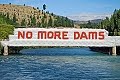
Work starts on Hawea kayak park
By Lucy Ibbotson, on Monday 20 June 2011
Otago Daily Times
After dozens of different designs and site evaluations, 14 consent approvals and nearly 10 years of planning, Central Otago whitewater enthusiasts' dream of a "whitewater play park" on the Hawea River is about to become reality.
Preparation work began recently at the site of the park in the river next to the Camp Hill Rd Bridge, at Hawea Flat. The project has been a long-held vision of Central Otago Whitewater Club stalwarts Roy Bailey and Gordon Rayner.
The park will cost more than $500,000 to build and will be funded by Contact Energy as a mitigation measure agreed upon by Contact and the club as part of Contact's suite of resource consents for the Clutha catchment, applied for in 2001.
Mr Bailey said the park would have two large weir structures to restrict the flow of the river and create "play waves" for kayakers. Rock for the river enhancements will be transported during the next fortnight from the building site for the National Transport and Toy Museum's new exhibition hangar, at Wanaka Airport.
Fulton Hogan is working on site, levelling an area for the rock to be stored and creating a car park. The river enhancements will be added between February and June next year. The park has been designed by top whitewater park designer Scott Shipley, of the United States.
During the years since the idea was first mooted, consents from the district and regional councils, Department of Conservation and other organisations had been needed, along with considerable consultation with the kayaking community and analysis of overseas whitewater play park designs. But the work and the nearly decade-long wait would be worth it, Mr Bailey said.
"For us, it will be great. We've got somewhere to go where we know there's going to be a wave working the whole time that we can play on and it will be really great for the development of the sport."
Contact Energy engineer Denis McEntyre said there would be minimal disruption to users of the Hawea River Track.
Monday, June 20, 2011
Work Starts on Hawea Kayak Park

Monday, November 1, 2010
POWER Struggle
POWER Struggle
Saturday 30 October 2010
The Press
Wild river, a raft, a safety briefing.
Glenn Murdoch, our good natured and we hope responsible guide, goes through the drill. Forward paddle, backward paddle, hold, stop. Drambuie for everyone if you lose your paddle.
Then he gives us the worst-case scenario. This is when the raft capsizes with the crew in the river and not necessarily attached to the boat.
"Keep your legs in front of you and your head looking down the river," he instructs.
The chances of tipping our bulky craft seem remote to a rookie like me but Murdoch, I guess, has to go through the motions like a flight attendant giving a spiel about the aircraft crashing.
We are on the Mokihinui River, which is in a remote northern corner of the West Coast, about 40 kilometres north of Westport. The launching point for our expedition is well inland, just below the fork in the river where the North and South branches meet and just above the 16km Mokihinui Gorge.
If state-owned Meridian Energy wins the day, most of the gorge will flooded up to an 85-metre dam to be built about 15km from the river's mouth. The resulting 14km-long lake will inundate 225 hectares of pristine lowland forest and obviously the stretch of wild river we hope to travel.
Meridian has the project on first base by obtaining the required resource consents from the West Coast Regional and Buller District councils. In March, commissioners decided, two to one, to grant the consents. The Department of Conservation (DOC), Forest & Bird and Whitewater NZ are appealing and the Environment Court is expected to hear the case in 2012.
Forest & Bird field officer Debs Martin, who is sharing a raft with Green Party co-leader Russel Norman (among others), explains Meridian faces another difficult hurdle: for the dam to go ahead, Meridian needs either permission from DOC to flood the land or it needs to acquire the DOC land by swapping it for other land which will provide a net benefit to conservation. Meridian has offered 700ha of land, two blocks of which are in the Mokihinui catchment below the dam.
DOC has completed its evaluation and a draft report recommends a firm "no" to Meridian on all counts. The final decision must be made by the conservation minister.
Martin hopes the area will end up in a conservation park, a process that was "on the table" before Meridian began the consent process.
She accepts the minister could direct the department to withdraw but thinks that unlikely because DOC has thrown "unprecedented" resources at the fight.
It all looks very difficult for Meridian but its Mokihinui project manager, Chris Evans (not on the trip), who has worked on the project for four years, says Meridian will persevere, concentrating for the moment on the appeal. Meridian has withdrawn its DOC flooding application so it can enter more open discussions.
The search for land to satisfy DOC continues, he says: "It's not an easy task when DOC already administers 80 per cent of land on the West Coast."
Back at the river, the launch is getting closer. About 120 people have gathered for a 6.30am start on a dull but mercifully dry morning.
Evidence before the commissioners showed only about 300 people use the area each year. We are certainly going to boost the average.
The event has been organised by the Christchurch White Water Canoe Club, more as a statement than a protest. The assemblage has its fair share of greenies but white water people come in all sorts of political stripes. Norman is the only politician on the trip.
The first step is for the rafts and kayaks to be bundled into nets and slung beneath helicopters for the trip up to the forks. One whitebaiter has set his net in the river just below the very site where the gear and people are loaded. In a scene reminiscent of Apocalypse Now, three helicopters flying neatly behind each other descend in an urgent racket of whining rotors.
The white water people are obviously not keen on the power project. The proposed lake does not stop them using the higher and difficult North Branch of the river but it means they face a dull 14km flat paddle on the descent which is currently broken by numerous boulder- strewn rapids, quieter stretches of green water, sandy beaches, striking rock features and healthy bush.
They concede their kayaks and rafts are not often seen on the river. As the day of our adventure shows, getting kayaks and rafts up the river is a major and expensive exercise.
Although the commissioners saw the loss of white water recreation as a "significant effect" they considered the dam would provide "a more diverse range of opportunities to a much wider group of people".
Hugh Canard, a Christchurch economic development and tourism consultant, whose heroic organisational abilities make the Mokihinui statement such a success, doesn't buy that argument.
He likens his white water colleagues to the endangered blue ducks who will be supplanted by the dam lake.
"We have the same rights as anybody else. Numbers shouldn't come into it. We are saying we are the blue ducks who have been using the river and minding their own business. Then along comes whoever and wants to take it away. You're going to displace blue ducks and introduce mallards."
While a lake would no doubt increase patronage of the area, by that logic a gondola up Aoraki/Mt Cook would be fine because it would do the same thing for the mountain, he says.
In his view the commissioners overlooked that the Mokihinui is one of only three reasonably accessible rivers on the West Coast that can be used by the majority of competent kayakers.
People who want a lake experience on the coast are spoiled for choice with about 100 naturally formed lakes that are under-utilised, he says.
Canard, 68, who has been kayaking since his late 30s, worries the lake will end up like Lake Dunstan at the head of the Clutha Dam - "dead".
"In my lifetime I've seen one river after another either getting diverted, drained or dammed. We've only got 20 per cent left. That's why the Mokihinui is important."
Thursday, September 16, 2010
F&B Disappointed At Nevis River Appeal
Forest & Bird disappointed at Nevis River appeal
Forest & Bird, on Thursday 16 September 2010, 9.30am
Scoop.co.nz
Forest & Bird is disappointed that Pioneer Generation is appealing the decision by a special tribunal to forbid dams on the Nevis River in Central Otago.
Last month the special tribunal allowed a proposed amendment to the water conservation order to ban dams on the Nevis River, which is home to a unique population of native fish, the Gollum galaxiid (Galaxias gollumoides).
The tribunal said banning the damming of the river would protect the rare native fish from the impact of hydro schemes proposed by Pioneer.
Forest & Bird Otago/Southland Field Officer Sue Maturin said the tribunal had accepted there was a compelling case to ensure the protection of this special fish species.
“We are disappointed Pioneer cannot accept there are other values that outweigh their desire to exploit one of the least modified rivers in Central Otago,” Sue Maturin said.
“We believe there are better options for renewable energy than damming our last wild rivers.”
The Nevis River is part of the Clutha catchment. Its source is at the southern end of the Hector and Garvie Ranges, from where it flows 50 kilometres northeast until it meets the Kawarau River, near Queenstown.
The special tribunal last month found in favour of a Fish & Game application, supported by Forest & Bird and other organisations, which removed conditions from the water conservation order that would allow a dam to be built.
The tribunal agreed the Gollum galaxiid was an outstanding feature needing protection, saying a dam could lead to the introduction of fish predators and other risks to this unique species.
The Nevis is also treasured by kayakers, rafters and fishers in its wild state.
Saturday, June 19, 2010
Wind-Farm Battle To Resume
Wind-farm battle to resume
By Lynda Van Kempen, on Saturday 19 June 2010
Otago Daily Times
The next round in the battle to decide whether the southern hemisphere's largest wind farm should be constructed on the Lammermoor Range in Dunedin starts on Monday.
Five days have been set down for Meridian Energy's appeal against an Environment Court decision declining consents for the proposed $2 billion Project Hayes wind farm.
Justices Chisholm and Fogarty will preside over the hearing in the High Court at Dunedin and only points of law can be addressed in the appeal.
Any party unhappy with the result of the hearing can appeal the decision to the Court of Appeal.
Meridian planned a 176-turbine wind farm on 92sq km of land, making it the largest in the southern hemisphere with the capacity to produce about 630MW of energy each year: enough to power about 263,000 average homes.
In 2006, Meridian lodged resource consent applications for Project Hayes with the Central Otago District Council, and the following year with the Otago Regional Council.
Several individuals and environmental and recreational groups opposed the consents being granted and appealed to the Environment Court.
The 350-page Environment Court decision was released last November.
The court said the negative effects of the wind farm on the landscape, heritage and recreation outweighed the positive benefits to the region and to the country of providing a large quantity of renewable energy.
The court found the project was inappropriate in such an "outstanding natural landscape" and said it was extraordinary that no cost-benefit analysis had been done on the project.
Meridian's "failure to consider alternatives properly" was another factor towards declining consent the court decision said.
Parties involved in the hearing next week include the Central Otago District Council, Otago Regional Council, the Maniototo Environmental Society, Upland Landscape Protection Society, John, Sue and Andrew Douglas, Eric and Cate Laurenson, Ian and Sarah Manson, Gaelle Soguel Dit-Piquard, Ewan Carr and Roch Sullivan.
Friday, February 6, 2009
Democracy Takes a Dive
RMA changes swing against ordinary Kiwis
Tuesday, 3 February 2009, 5:18 pm
Press Release: Forest And Bird
Conservation group Forest & Bird believes changes to the Resource Management Act announced today will make it harder for ordinary Kiwis to have a say in protecting the environment from unsustainable development. "It will be a very sad day for the environment and our communities when only those who can afford expensive lawyers can have a say," Forest & Bird Advocacy Manager Kevin Hackwell says.
"Most of the proposed changes will make the RMA easier for very big, wealthy companies and rich individuals." The first thing many affected individuals or communities will know about a development is when the bulldozers arrive, with the proposal to make it less likely that resource consents will be notified.
"Removing most of the checks and balances and the right of appeal on the development of regional and district plans is also a big concern," Kevin Hackwell says. "Rather than speed up the planning process, the proposals will inevitably lead to poorly constructed and inefficient plans that will create problems for everyone.
"Forest & Bird welcomes disincentives for trade competitors to misuse the Act, but ordinary Kiwis and community groups will probably have to raise large bonds as security of costs unless there are robust criteria for how these disincentives are applied. This will be on top of a 900 per cent increase in the cost of lodging an appeal to the Environment Court (increased from $50 to $500). By comparison, the increased fines for corporate polluters will rise by just 300 per cent.
The proposal to remove the Minister of Conservation’s powers to make decisions on restricted coastal activities is a real concern. "The Minister represents the Crown’s ownership of the coast and as the ‘owner’ the Minister should be able to have the final say," Kevin Hackwell says. The logical next step would be to take away private landowners’ rights to say no to someone else’s proposed development on their land.


