
By Lynda van Kempen, on Friday 8 August 2014
Otago Daily Times
Cromwell could become ''the hub'' of new cycle trail networks
if a proposed Luggate to Cromwell trail is successful, the
trail promoters say.
The Upper Clutha Tracks Trust was given a grant of $25,000 by
the Central Lakes Trust this week for a feasibility study
into the proposed 40km trail.
Tracks trustee and treasurer John Wellington said the
proposed trail would connect the Upper Clutha trail network
to Cromwell and tie in with the wider Central Otago cycle
trail network.
It would link with the proposed Cromwell to Gibbston trail
and the proposed Cromwell to Clyde one as well, he said.
''Bit by bit, various groups have taken up the challenge of
forming trails along the Clutha River and we're working our
way towards Cromwell,'' Mr Wellington said.
When the proposed trails were completed, Cromwell would be
the ''hub'' of the new trail network, he said.
The Luggate to Cromwell trail was mostly within the Central
Otago district, on the true right of the Clutha River, and he
believed the feasibility study would show it was ''do-able''.
''Then it will be a matter of getting other parties on side,
talking to adjoining landowners and starting fundraising.''
The aim would be to have the trail on public land where
possible, but some of the route would cross private land, so
the trust would have to canvass landowners and negotiate with
them.
Mr Wellington said the feasibility study could be completed
by November and would include estimates of the trail cost.
''It's a longer trail than we've built previously, but it
won't have much in the way of structures, so that will make
it cheaper, but we really don't even have a ballpark figure
at the moment.''
Unlike the trails on the ''Great Rides'' national cycle
network, part-funded by the Government, this trail would have
a ''lower scale finish'' and was likely to be 1.5m wide,
narrower than trails on the national network, which were 2.5m
to 3m wide. That would make it cheaper to develop.
''As soon as the feasibility study gives the green light,
we'd look at getting it under way, maybe doing it in stages
if we need to,'' Mr Wellington said.
Among the other grants by the Central Lakes Trust in its
latest round of funding were $1500 for the Wanaka Preschool
Early Childhood Centre, for two additional shade sails, and
$4750 to the Drybread Cemetery Trust for a new concrete
burial strip for headstones and the creation of 40 new
graves. The Alexandra Musical Society was also granted a
guarantee against loss of $7500 to enable it to stage the
musical All Shook Up next month.
Showing posts with label Queensberry. Show all posts
Showing posts with label Queensberry. Show all posts
Friday, August 8, 2014

Wednesday, May 2, 2012
Windfall For Contact Shareholders
Windfall for Contact shareholders expected
Tuesday 1 May 2012
TVNZ ONE News
Contact Energy shareholders can expect a substantial boost to cash flow from 2014 onwards as the company completes geothermal projects, winds back major capital spending and seeks to sell some of its $100 million of development land holdings.
The company's decision to all but abandon long-held hydro-electricity developments on the Clutha River was part of a wider drive to strip capital project costs out of the business for the time being, said chief executive Dennis Barnes.
Contact cited weak national electricity demand, the challenge of gaining resource consents and better options elsewhere for putting on ice hydro-electricity projects that could potentially double its output from the Clutha River, and beginning a process of selling land holdings in the area.
The Clutha options were not commercially viable "in the foreseeable future".
Contact already has 752 MW of installed capacity at the Clyde and Roxburgh hydro stations on the Clutha, and inherited options for developments at Tuapeka Mouth, Beaumont, Queensberry, and Luggate totalling 763MW when it was corporatised in the mid-1990's.
Since then, the company has periodically examined its Clutha options, while fending off criticism from local communities that a lack of clarity about its plans was impeding economic development.
A review of calculations last made in 2008 had shown roading infrastructure costs would be far higher than originally estimated, while the size of each project was too large to consider building for the foreseeable future.
Asked whether the decision signalled the end of "big hydro" in New Zealand, Barnes said: "I don't believe so, but I can't answer the question for 15 to 20 years."
It would be 2025 "at the earliest" before any of the Clutha options made sense to re-examine.
"We will stop spending money on it," he said. "Project development pipelines need to show a return and we needed to take the community to an honest point.
We decided we wouldn't do any work for seven, eight or 10 years, and it was fair to tell them that."
Contact also had more attractive geothermal and wind development options than any of its large hydro prospects, although it has extended for one year its resource consents on a small hydro scheme attached to the control gates on Lake Hawea, the only controlled storage lake on the Clutha system.
Barnes said one of his chief tasks in the last year had been to strip out capital development costs from the business, and to start implementing a more active land management policy to rationalise the company's approximately $100 million portfolio of development and other land holdings around the country.
The Clutha decision is still a step away from complete abandonment, with Contact proposing in some cases to sell land with encumbrances either to allow a future hydro development or preventing sale to a competing hydro developer.
"A dammed river is a very significant energy resource and will have a value over a timeframe," he said.
The company is taking a similar approach to land purchased for its mega-wind farm development in the North Island, on the coast north of Raglan, selling property with a future development right attached.
Contact owned only about 20% of the land it required to build any of the proposed Clutha dams.
No decision had yet been made on exactly how much of its land holdings would be marked for disposal, Barnes said.
He conceded also that resource consents in the lower South Island were likely to take longer and be more costly to obtain than in some other parts of the country.
"Our view is that if you take your time and are transparent, they are consent-able," he said. "But in that part of the country, the community conversations take longer and cost more. It's different from Wairakei, where the community embraces geothermal development."
Barnes said that once the 166MW Te Mihi geothermal plant was completed in 2013 that would bring to an end four years in which Contact had committed an average of $500 million of capital annually.
"It will drop to $100 million or less. The balance goes to cash flow. You will see that very strongly in 2014."
Contact shares traded unchanged at $4.85 on the NZX and have declined about 8% this year.
Contact Should Atone: Resident
Contact should atone: resident
By Lynda van Kempen, on Wednesday 2 May 2012
Otago Daily Times
Beaumont resident Margaret Healy says she can finally "chuck away the snorkel" after living for years with the threat of the area being flooded if a hydro dam was built on the Clutha River nearby.
Contact Energy announced on Monday it was dropping its plans for further hydro development on the river, saying none of the options for dams at Beaumont, Tuapeka, Luggate and Queensberry were viable "in the foreseeable future".
Beaumont residents and former residents who opposed further hydro development on the Clutha welcomed the decision as "long-awaited and absolutely marvellous", said Mrs Healy, who is the secretary-treasurer of the Beaumont Residents Group.
It had been daunting to live for the past 20 years with the prospect of a dam that might flood the area "hanging over" them.
Contact owed Beaumont some compensation for the impact that uncertainty had had on the community, she said.
"The threat of the dam has changed the whole area and influenced a lot of things over the years, including the population in the area. The local shop closed as well as the school, and people stopped buying land here and took out orchards. We feel Contact owes us some compensation to make up for all that."
Compensation could take the form of the community being "gifted" the former shop building, which was owned by Contact, or the company could contribute to a new roof for the Beaumont Hall, Mrs Healy said.
Asked whether Contact would offer any "compensation" to Beaumont, Contact group communications manager Janet Carson said: "We're part of this community and contribute where we can.
"We have been working with locals about the shop for some time and will continue to see what's possible.
"We have also, just today, received a request for assistance with other [Beaumont] community-related matters, which we are also considering," she said.
Contact was involved in community projects throughout the region but the contributions it made should not be viewed as "compensation", she said.
Mrs Healy said Beaumont was a special place and she had received a steady stream of emails and phone calls yesterday from people saying they were "delighted" at the cancellation of the dam plans.
"Lots of them were people who used to live here.
"One even said, 'Hooray, I can still be buried in the Beaumont cemetery when I die'."
Under the proposal for a dam at Tuapeka Mouth, the cemetery would have been flooded, along with the Beaumont township.
Mrs Healy and her husband have lived on a 0.4ha block of land near the Beaumont bridge for the past 35 years.
Plans for a Tuapeka dam were first mooted in 1965 by Contact's predecessor, the Electricity Corporation of New Zealand, and the project has been reconsidered several times since then.
"It appears that threat of a dam has been virtually removed now that Contact is concentrating on other energy projects like geothermal projects," Mrs Healy said.
"We used to joke we'd be well under the water here and we'd need a 30m snorkel ... well, now I can chuck away the snorkel."
There would be nothing holding back progress in the area now that uncertainty was gone, she said.
People would be able to plan for the future and buy and sell land freely.
Decision On Dams No Surprise
Decision on dams no surprise
By Lucy Ibbotson, on Wednesday 2 May 2012
Otago Daily Times
Contact Energy's decision to drop its hydro development plans for the Clutha River has come as no surprise to local government leaders in the district.
Clutha Mayor Bryan Cadogan had been "semi-aware" of Contact's intentions for some time.
He said the prospect of dams on the Clutha River had "polarised the community", and it was good to have some closure on a long period of uncertainty.
"I suppose if nothing else it gives certainty now for the future because for so long we've been saying 'Imagine if the dam happened' ... It's better to be dealing with the facts and move on with reality ... so onwards and upwards."
Mr Cadogan said there would never have been a "ready acceptance" of hydro development from the community if the project had proceeded.
"To have development in the district is something that we're always looking for, but it's got to be the right development and it's got to have community support."
The news Contact had cancelled its dam plans was not unexpected for Central Otago Mayor Tony Lepper, either.
"Only because I thought they were expensive power projects to go through with and obviously they've come to the same conclusion," he said.
"It's probably disappointing to miss out on the economic benefits, but I'm sure there's other economic benefits to come out of that river and we'll just have to make the most of those."
Mr Lepper said on a personal level, he was "rapt" there would be no dam proceeding at Luggate, where he regularly kayaked.
"I think that's one of the nicest stretches of river in New Zealand and I play on it all the time.
"I'm very pleased that it's going to be around for a bit longer."
Queenstown Lakes deputy mayor Lyal Cocks said the decision was "appropriate", based on information Contact had provided throughout the process and the division the dam proposals had caused within the district's communities.
"It's been an issue that we've been on the edge of for a while watching the progress ... I think it's an appropriate decision looking at the way the numbers stack up as they've [Contact] indicated to us."
He said there were other options for power generation that were more feasible
Contact Ditches Clutha Hydro Plans
Contact ditches Clutha hydro plans
By Che Baker, Tuesday 1 May 2012
Southland Times
Contact Energy has announced it will no longer proceed with developing hydro generation on the Clutha River.
Contact chief executive officer Dennis Barnes said investigations during the past three years at four different sites along the river, at Queensberry, Luggate, Tuapeka Mouth and Beaumont, have shown none of the options was viable.
"It has become clear that all future Clutha hydro options came in at a much higher cost per megawatt to build than the next available new geothermal and wind generation options,'' Mr Barnes said.
The decision to stop development of the hydro options was based on an assessment of the economics of each option and took into account a range of technical, environmental, social and cultural factors, he said.
As part of Contact's land management strategy, it will be reviewing its land holdings near the Clutha River.
Tuesday, May 1, 2012
Contact Pulls Plug On Dams
Contact pulls plug on dams
By Lucy Ibbotson, on Tuesday 1 May 2012
Otago Daily Times
Contact Energy has withdrawn plans for further hydro development on the Clutha River and will review management and ownership of its land holdings near the river.
The decision, announced yesterday, comes after Contact signalled in February delays in its plans to develop a new hydro-generation facility on the Clutha River, saying the project was on the "back burner" and geothermal energy remained a priority.
Contact spokeswoman Janet Carson said at the time the four Clutha hydro-development options, at Tuapeka Mouth, Beaumont, Queensberry and Luggate, "remained open", but were "more likely to be further down the track, probably into the next decade".
Contact announced in 2008 it was revisiting plans for dams on the upper and lower Clutha, costing between $300 million and $1.5 billion, which were originally proposed more than 20 years ago by its predecessor, the Electricity Corporation of New Zealand.
Contact hydro projects manager Neil Gillespie confirmed last night he had notified "as many of the stakeholders and people that we've talked to over the last three years" of the formal decision to end the Clutha hydro-development project.
"Contact has decided not to proceed with any of the options being investigated for hydro-generation development on the Clutha at this time and has ceased all work pertaining to it," Mr Gillespie's email yesterday to affected parties said.
However, he told the Otago Daily Times last night he could not permanently rule out hydro development on the river, as "who knows what the future holds".
Contact will now review future management and ownership of all its land holdings near the Clutha River as part of its ongoing land management strategy.
Mr Gillespie was unable to provide details on the extent of that land, but confirmed selling it was "one of the options that could come out of [the review]".
In a media statement, Contact chief executive Dennis Barnes said the company's investigations during the past three years had shown none of the options considered were viable for development.
"It has become clear that all future Clutha hydro options came in at a much higher cost per megawatt to build than the next available new geothermal and wind-generation options. On current demand forecasts, the Clutha options are not economic in the foreseeable future," Mr Barnes said.
"Contact has a range of new generation in the pipeline, either confirmed, consented or under construction, to meet foreseeable electricity demand for our customers."
Clutha River Forum, an alliance of river and conservation groups opposed to "think-big" hydro development on the Clutha, was set up in 2009. Forum co-ordinator Lewis Verduyn, of Wanaka, said yesterday's announcement was not a surprise.
"For some time now, we have known that New Zealand energy companies have been experiencing a low-growth environment in the wake of the global financial crisis," Mr Verduyn said.
"Consumers are cutting back, capital costs remain high, lake storage levels remain erratic, and there is now sufficient new generation either coming online or consented for some years ahead.
This decision, then, must be welcomed as a sensible one for Contact shareholders and river communities alike.
"What we need most now are energy-smart technologies, since efficiency is less than half the cost of new generation. It would be reasonable to say that unless we return to pre-2008 economic growth, which isn't going to happen, that the era of large dams is over."
Mr Gillespie declined to comment about how much Contact had spent developing the Clutha project, as it was "commercially sensitive".
Thursday, February 23, 2012
Clutha Hydro Plans Stalled
Clutha hydro plans stalled
By Lynda Van Kempen, on Thursday 23 February 2012
Otago Daily Times
Contact Energy has signalled delays in its plans for further hydro development on the Clutha River, saying the project is on the "back burner" and other developments have greater priority.
In 2009, Contact announced it was revisiting plans for dams on the upper and lower Clutha, at Tuapeka Mouth, Queensberry, Luggate and Beaumont, costing between $300 million and $1.5 billion. The schemes had been proposed by Contact's predecessor, the Electricity Corporation of New Zealand, more than 20 years ago.
Contact chief executive Dennis Barnes was reported this week as saying the Clutha hydro project was on the "back burner". He was unavailable for comment yesterday, but Contact spokeswoman Janet Carson said geothermal energy remained the priority development area for Contact.
However, it continued to investigate wind, hydro and gas-fired developments. Contact was still assessing the four Clutha hydro development options and they "remained open".
"Our conversations, data assessments and research undertaken to date are showing that pursuing further hydro development is more likely to be further down the track, probably into the next decade, and we are considering the implications of that."
She declined to elaborate.
The Clutha hydro project was on the "back burner", as opposed to "priority developments" under construction such as the Te Mihi power station, near the Wairakei geothermal power station, northwest of Taupo, Ms Carson said.
There had been no "change of priority" by the company towards hydro development. She declined to comment on how much Contact had spent so far developing the Clutha project.
The Clutha River Forum, an alliance of river and conservation groups opposed to "think-big" hydro development on the Clutha, was set up in 2009. It launched a "Option 5 - no more dams" campaign.
Asked for comment about delays to the hydro project, forum co-ordinator Lewis Verduyn, of Wanaka, said the world was changing rapidly "and these former business-as-usual projects are simply not realistic".
"We've always considered further `think-big' dams on the Clutha to be inappropriate, outdated and uneconomic. Now, Contact is facing a landslide of economic and environmental issues that were largely unforeseen just a few years ago.
"With electricity demand falling, the high cost of servicing capital and record low flows in the Clutha River, it's difficult to imagine how these plans could ever be viable in the future," he said.
Contact's stance on the project comes in the wake of the decision last month by Meridian Energy to shelve its plans for a $2 billion wind farm on the Lammermoor Range. Meridian chief executive Mark Binns said shelving the Project Hayes wind farm was "a prudent commercial decision", as the company had other higher-priority projects.
Asked at that time if the decision had any impact on the Clutha hydro plans, Contact hydro projects manager Neil Gillespie said the hydro plans were at a different stage from those of Meridian's Project Hayes.
It had a consented project, while Contact had yet to narrow down the options and was "quite some time away" from thinking about resource consents.
Tuesday, January 24, 2012
Contact Undeterred By Hayes Decision
Power companies undeterred by Project Hayes decision
By Lynda Van Kempen, on Tuesday 24 January 2012
Otago Daily Times
In the wake of the Project Hayes decision, it is business as usual for Contact Energy, weighing up options for hydro development on the Clutha River, and Pioneer Generation, looking at small-scale wind farms.
Meridian's decision to shelve its planned $2 billion wind farm on the Lammermoor Range in the Central Otago has had little impact at this stage on Contact and Pioneer's plans.
Contact Clutha hydro project manager Neil Gillespie said the hydro plans were "at a completely different stage to what Meridian was at when it pulled the plug.
They had a consented project.
"We have yet to narrow down the options and decide on a favoured option and we're quite some time away from even having to think about resource consents," Mr Gillespie said.
Contact has been investigating four main hydro options on the upper and lower Clutha, proposing dams at Tuapeka Mouth, Queensberry, Luggate and Beaumont costing between $300 million and $1.5 billion.
The schemes were mooted more than 20 years ago and originated from proposals by Contact's predecessor, the Electricity Corporation of New Zealand.
Ultimately, the Project Hayes decision would have an impact "when we're looking at starting to build, but we're nowhere near that stage", he said.
In the meantime, the company was consulting the community, and analysing options.
The community's views, technical and engineering studies and the effect on the environment were all factors which would be taken into consideration, Mr Gillespie said.
"Nothing's changed for us in what we're doing because of Meridian's decision."
Pioneer Generation chief executive Fraser Jonker said its plans for wind farms were on a vastly smaller scale than Meridian's.
The Environment Court decision in 2009, which cancelled resource consents for Project Hayes, saying the wind farm was inappropriate in an outstanding natural landscape, had influenced the type of wind farm proposals Pioneer had been investigating.
"We would never attempt to place a wind farm in that type of a landscape because it would be too much of hurdle to get it consented. "The projects we have under more investigation at the moment have taken that sort of landscape into consideration," Mr Jonker said.
Pioneer was still talking to several Otago and Southland farmers about the possibility of constructing small-scale wind farms on rural properties, along similar lines to its nine-turbine Mt Stuart wind farm in South Otago.
Friday, January 6, 2012
Contact Vies For More Time
Contact vies for more time to establish hydro scheme
By Lucy Ibbotson, on Friday 6 January 2012
Otago Daily Times
Contact Energy has asked for more time to establish a hydroelectric scheme at Lake Hawea, citing the global economic downturn and seasonal construction constraints as reasons for the delay in exercising the project's original consent.
Contact has proposed the construction and operation of a small-scale hydro-generation facility in the outfall control structure of the existing Lake Hawea dam.
It secured an original land use consent from the Queenstown Lakes District Council in 2007 for the 17.2MW Hawea Gates Generation Project, due to lapse on February 7.
Contact also holds associated consents granted by the Otago Regional Council with expiry periods of 10 and 15 years, lapsing on various dates in 2017 and 2022. It wants to extend the expiry date of the QLDC consent another five years, to July 16, 2017, to coincide with the regional council consents.
Contact hydro-development project manager Neil Gillespie said, while Contact was "continuing to progress, giving effect to the consent", it was not possible to complete the final design and construction of the project within the current QLDC consent period.
The extension application said a combination of "technical, practical and economic constraints" were behind the delay.
The project was not straightforward as it involved "retrofitting a modern tailor-made generation plant to existing infrastructure", making the economic risks of project high, the application stated.
A final investment decision could not be made by the current lapse date, a situation "exacerbated by the global economic downturn and associated slower-than-anticipated growth in electricity demand since 2008".
Also, because initial construction work had to be performed "in-river", the project was limited by the ORC consents and seasonal constraints, which had contributed to its extended duration.
The project requires modifying the Hawea dam structure, on Contact-owned land, by constructing twin powerhouses; installing a generation plant; altering the intake structure; installing penstocks through the existing sluices; strengthening some existing works; and carrying out earthworks and upgrades to access roads.
Mr Gillespie said the extension would help achieve the objectives of the QLDC district plan and was an efficient and sustainable use of the resources.
"It's a great little project, renewable, small scale, and makes the most of an untapped resource, the water already being spilled through the dam.
"Importantly, the development involves no long-term changes to the river environment."
It would take up to 36 months to complete the final design and construction, and the expected timeframe to complete all work is no later than 2017, in line with the current ORC consents.
Contact was "still working through [geotechnical] information" on the four other Clutha River locations identified as options for hydroelectric dams - Luggate, Queensberry, Beaumont and Tuapeka Mouth - Mr Gillespie said.
Saturday, October 29, 2011
Dam Plans At Engineering Stage
Dam plans at engineering design stage: Contact
By Matthew Haggart, on Saturday 29 October 2011
Otago Daily Times
Neil GillespieEngineering design plans for hydro-electric dams on the Clutha River are being drawn up as Contact Energy considers the options for its power generation schemes.
The power generation company carried out a ground-drilling project near Luggate earlier this year to complete a round of geotechnical investigations at the four locations identified as options for hydro-electric dams.
Contact Energy hydro projects manager Neil Gillespie reiterated there was no preferred site for a possible hydro-electric scheme.
The completion of geotechnical investigations meant Contact was now at a stage of "engineering and design" for the potential hydro dam structures - alongside its ongoing consultation with affected communities, he said.
"Now that we have all the [geotechnical] information, we'll use that to look at what kind of dam might be built and what it might look like," he said.
Engineering designs would also give an indication of what costs might be involved, he said.
"The big thing for us to understand is the engineering and environmental costs. This also gives a feel for the economics, which in turn enables comparisons of whether it is viable to construct and when."
A definitive timeframe for when any engineering design plans might be completed to be put forward for community consultation remained "somewhere in the near future", Mr Gillespie said.
"Realistically, we hope to have it completed by some stage next year ... This is open to change."
In 2009, Contact dusted off decades-old plans for Clutha River hydro-electric schemes, deciding to revisit options for potential dams at Luggate, Queensberry, Beaumont and Tuapeka Mouth.
The company has spent the past two years investigating its options at the four potential dam sites and consulting communities, amid opposition from Clutha River protectionist groups.
Mr Gillespie said there was "not a huge team" working on the project.
An "in-house" team of three people was involved with an overview of the project, while external consultants were contracted "as required".
"My focus and the most important part of this project is picking up on the community side of feedback to ensure we can understand those views," he said.
An engineering and design perspective was about assessing the merits of the four options. He declined to specify what ground conditions the geotechnical investigation at Luggate had revealed and whether these were similar to those at other sites.
There were geotechnical "commonalities" at all four sites, which enabled the design team to work "across the options" at each respective location, given the signalled engineering plans for the different hydro dam schemes.
Friday, May 27, 2011
Luggate Walking Track Opening
Walking track to open this Sunday
By Marjorie Cook, on Friday 27th May 2011
Otago Daily Times
The Upper Clutha Tracks Trust project has been done in consultation with the Luggate Community Association, Department of Conservation, Wanaka Community Board, Contact Energy and other groups.

It is an extension of the Upper Clutha Track that begins at Albert Town.
Walkers and cyclists can now travel below the Luggate Red Bridge to the Nook, across a new bridge over the Luggate Creek and up to Luggate township, finishing a short distance from the Luggate Hotel.
"It's now truly pub to pub," trustee John Wellington said of the trust's trail network, which also includes Wanaka, Albert Town, Cardrona and Lake Hawea.
With Luggate now on the trail, just Hawea Flat and Makarora are out of the loop.
But the trustees said they were trying to think of ways to eventually link those townships to the network, plus extend the Luggate track down to the Queenstown Lakes District Council boundary at Queensberry.
Mr Wellington said the idea for the Luggate Creek extension was formed before the Upper Clutha Track between Albert Town and the Luggate Red Bridge had been completed.
Initially, the trust had wanted to cross the bridge and continue the track downstream on the Tarras side of the Clutha River.
That changed when the trust and association met to discuss access to the Nook, a whirlpool in a bend in the Clutha River.

Devil's Nook from Luggate Creek Track
Central Otago track advocates are also working on trails with the goal of a track all the way to Cromwell, Mr Wellington said.
Another Upper Clutha Tracks Trust concept is to complete a loop back from the Luggate Red Bridge to Albert Town on the true left of the Clutha River.
Mr Wellington said the trust was in the very early stages of developing that proposal and had to first negotiate with landowners, including Contact Energy.
"There is public land all the way up but we will have to also talk to neighbours," Mr Wellington said.
The Luggate Creek Track has cost about $100,000 to build so far, with the Department of Conservation and contractor John Sutton contracted to do parts of it.
That is not a final figure because the extension below the Nook has not been completed.
There is a new bridge across the Luggate Creek near the Nook.
The opening of the track will be celebrated at 10am on Sunday. Signposts explaining how to get to the track will be put on State Highway 6 at Luggate.
Friday, May 6, 2011
Drilling For Dam Bedrock At Luggate
Down-to-earth approach does it
By Marjorie Cook, on Friday 6 May 2011
Otago Daily Times
A McNeill Drilling rig began working above the Clutha River near the Luggate Red Bridge yesterday, as Contact Energy investigates whether geological conditions are suitable for the construction of a hydro-electricity dam on the Clutha River near the Nook.
The drilling company expects to be in the area for three to four weeks. Test sites are on both sides of the river.
Contact Energy's other possible Clutha River hydro dam options are at Queensberry, Beaumont and Tuapeka Mouth, which are at more advanced stages of geotechnical investigation. Contact Energy has not determined which of the four sites is its preferred development option.
Friday, April 29, 2011
Contact Seeks Clutha Hydro Cash
Contact seeks Clutha hydro cash
By Che Baker, on Friday 29th April 2011
The Southland Times
Contact Energy has announced it is trying to raise $350 million dollars for future projects, including a hydro dam on the Clutha River, if any of the four sites it is examining are viable.
In a statement released yesterday, the company said it would be offering New Zealand and Australian shareholders the chance to buy discounted shares at $5.05 per share, 13.8 per cent lower than the market price, in an attempt to raise the funds.
Contact Group communications manager Janet Carson said the funds could be used to seek a consent for a hydro dam along the Clutha River if a suitable site were found.
The four sites being examined were at Luggate, Queensberry, Beaumont and Tuapeka Mouth.
A geological report for the Luggate site, the last site to be examined, was due to be completed next month.
Contact Energy Chief Executive Dennis Barnes said the company's strategy for growth was focused on developing a range of generation options, including geothermal, gas, wind and hydro, and constructing selected projects at the right time.
The offer closes on June 1.
Wednesday, April 27, 2011
Investigative Drilling Delayed
Investigative drilling delayed
Wednesday, 27 April 2011
Otago Dailt Times
The start of a drilling project to investigate whether ground near Luggate is capable of supporting a hydro-electric dam on the Clutha River has been rescheduled.
Contact Energy is carrying out the investigative drilling as part of four options being considered for possible hydro-electric schemes on the Clutha River.
A drilling rig had been scheduled to move in yesterday.
Contact's Clutha hydro project manager Neil Gillespie said a "moving target" for the commencement of the drilling project had changed.
The drilling rig contractor has been held up at another site in Central Otago and would start near Luggate once its commitments were completed elsewhere, he said.
An access road has been cleared for the drilling rig, which will work at a site upstream from the distinctive switchback river feature known as the Devil's Nook.
The geotechnical investigation and drilling programme near Luggate does not indicate the site is a preferred option for Contact to build a dam there, Mr Gillespie said.
Other possible Clutha River hydro dam options at Queensberry, Beaumont, and Tuapeka Mouth are at more advanced stages of geotechnical investigation, Mr Gillespie has said.
Wednesday, April 13, 2011
Drilling At Luggate Site
Drilling at Luggate site
By Matthew Haggart, on Wednesday 13 April 2011
Otago Daily Times
Contact Energy is undertaking a drilling project near Luggate to investigate whether geological conditions are suitable for the construction of a hydro-electric dam on the Clutha River.

threatened by Luggate dam
Contact Clutha hydro project manager Neil Gillespie, of Cromwell, said the geotechnical investigation and drilling programme did not indicate Luggate was the preferred option.
"The purpose is to gain more information on the geological conditions there. Currently, we have much greater detail on ... conditions at the other three possible sites [Queensberry, Beaumont and Tuapeka Mouth] than we do at Luggate and we want to gain a comparable level of information for all four possible future options," he said.
In 2009, Contact dusted off decades-old plans for Clutha River hydro-electric schemes, deciding to revisit options for the four potential dams.
The company has spent the past two years investigating the options at the four potential sites and consulting communities, amid opposition from Clutha River protectionist groups.
Mr Gillespie said a drilling rig was scheduled to begin exploratory testing to a depth of up to 30m at a site about 2km below the Luggate Red Bridge.
Upper Clutha River Guardians president Tim Ryan, of Wanaka, questioned the need for further investigation at Luggate when Contact had resource consent to install hydro-electric turbine generators at Lake Hawea.
"It is of major concern to us. Why aren't we seeing anything being built at [Lake] Hawea? Why do they have to go and investigate an area where a dam would destroy the whole valley back to Albert Town?" he said.
Mr Gillespie said there was still no expected time-frame for work to begin on installing turbine generators at Contact's Lake Hawea storage gates that would be capable of providing 17MW of electricity.
"Detailed" design plans were "yet to be completed", which would provide an outline for when construction might start.
However, Mr Gillespie did not know when those design plans for the consented turbine generators might be completed.
Clutha Matau-Au River Parkway Group chairman Lewis Verduyn, of Wanaka, said the Luggate dam proposal, "like all of Contact's old plans for large dams on the Clutha, is too destructive, too backward-thinking and too problematic".
Drilling was being carried out at the site to see if there was suitable bedrock capable of supporting large-scale foundations.
"They are doing their homework to further investigate costs associated with building dams. If there is no bedrock there, they may not be able to proceed because it could prove too costly," he said.
He also questioned the need for a dam, which, at nearly 1km wide, would have a profile across the Upper Clutha Valley "larger than the Clyde dam" and yet would generate only 86MW.
Mr Gillespie had consulted the River Parkway Group about its "geotechnical investigations" but "nothing I have learned about [their options] has made me feel better about the project", Mr Verduyn said.
Contact has already carried out preliminary digging at the drilling site, which is near where the Luggate Creek enters the Clutha River at the popular scenic area known as the Devil's Nook.
Mr Gillespie said pits about 4m deep had been excavated to check ground conditions before the holes were refilled.
The drilling-rig crew was expected to begin work after Easter, putting down six drill holes to depths of 10m-30m, during a projected three-week operation.
An ensuing geotechnical report about the potential site would be considered and would enable a clearer picture of possible costs of building a dam, he said.
The four sites:
Luggate: 25m-high embankment dam, located about 2km downstream of Luggate Red Bridge, creating 350ha lake extending 15km to near Albert Town.
Queensberry: 14m-high embankment dam to feed into either a 12km or 9.5km-long canal to down-river powerhouse, creating 240ha lake extending 9km up river to near Luggate.
Beaumont: 30m-high concrete gravity dam located about 2km from Beaumont township, creating 1100ha lake extending 29km upstream from dam.
Tuapeka Mouth: 50m-high concrete dam located about 2km upstream from Tuapeka Mouth, creating 3200ha lake extending 55km upstream to Millers Flat and flooding Beaumont township.
Monday, May 10, 2010
New Projects Will Mean Price Rise
New projects will mean price rise - Contact
By Lynda Van Kempen, on Monday 10 May 2010
Otago Daily Times
Contact's Clutha hydro project manager, Neil Gillespie, told a recent business forum in Alexandra that the energy company was still considering community issues and refining the cost of the four hydro scheme options for development on the river.
Dams are proposed at Luggate, Queensberry, Tuapeka Mouth and Beaumont.
No decision had been made on the preferred option or options.
"The cost is one of the significant issues, and the return for that cost," he said.
Cost estimates ranged from $350 million to $1.5 billion.
"There's a long construction time, so a long lead-in period before you make any money and we're still refining our costs to see if the projects are viable," Mr Gillespie said at the Otago Chamber of Commerce forum which aimed to give an overview of Central Otago in the year 2020.
"The key thing is under the current estimates, the price of power would have to go up to make the projects viable and that's about as palatable as a lot of other things, like a rates increase."
After the forum, Mr Gillespie said the comment about power prices related to any new generation schemes, not just the hydro schemes.
Contact Energy communications adviser Louise Griffin said any form of new electricity generation was expensive to construct and power prices would need to increase to make any new generation viable.
"Growing demand for electricity means we will need new power stations, which are more expensive to build and run, than existing power stations," she said.
New Zealand electricity prices reflected the cost of providing electricity and the cost of building new generation to meet this country's demand for power in the future.
A Contact Energy booklet on electricity prices said the New Zealand electricity market was unique in that most generation was from renewable sources and New Zealand was an isolated market with no means of importing or exporting electricity.
New power stations were more expensive to run than existing power stations, Contact said in the booklet.
The cost of energy for future electricity generation options was rising and the energy component in tariffs would have to increase to make new hydro and wind generation schemes viable.
Mr Gillespie told the forum that new hydro generation on the Clutha would meet the future demand for power and would complement wind-generated power schemes - "when the wind is blowing you can store water and not use your hydro resource".
Regardless of where any new generation scheme was located, or what it was, there would be detractors, he said.
However, with the growth in the region, there would continue to be a growing demand for electricity, which had to be met.
Thursday, April 1, 2010
Clutha Dam Protest On Luggate Bridge
Clutha Dam protest on Luggate Bridge
By Molyneux Rush, on Thursday 1st April 2010
Otago Daily Times (removed from source)
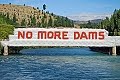
Residents of the Upper Clutha are bemused by a new sign that has appeared on the Luggate Bridge.

Overnight, the Luggate Bridge has become a protest banner.
A year ago, Contact Energy outlined proposed options for dams at Tuapeka Mouth, Beaumont, Queensberry and Luggate, costing up to $1.5 billion. Recently, the power company stated that it will announce its preferred option in the latter half of the year.
Last October, the Clutha River Forum – an alliance of several groups opposed to further dams on the Clutha River, launched an ‘Option 5 – No More Dams’ campaign, a reference to Contact Energy’s four dam options.
Members of the Clutha River Forum include the Upper Clutha River Guardians, the Clutha Mata-Au River Parkway Group, the Central Otago Environmental Society, Save Central, the Beaumont Residents’ Group, the Lower Clutha River Guardians, and Forest and Bird (Dunedin & Central Otago).
All of these groups have denied responsibility for the Luggate Bridge ‘No More Dams’ sign.
Contractors are currently repainting the iconic Red Bridge and have covered it with a fabric containment system. They arrived at work yesterday morning to find that the white cover on the NW side of the bridge had been turned into a banner. One worker, who didn’t wish to be named, said:
“Whoever it was, they must have accessed the side of the bridge using ropes because we found one left behind. We also found a compressor hose that doesn’t belong to us, so they used spray paint.”
A motorist reported seeing a group of people on the bridge after midnight but thought they were contractors working overtime to finish the bridge before Easter. Hours earlier, a Luggate resident saw “several students” parked near the bridge with a trailer covered in a blue tarpaulin.
A spokesperson for Contact Energy said that the power company was appalled by such “blatant environmental vandalism.”
The bridge painting contractors have been asked by “the powers that be” to remove the banner before it is seen by tens of thousands of people travelling to attend the Warbirds Over Wanaka airshow this Easter, which begins tomorrow, April 2nd.
Wednesday, March 24, 2010
Contact Clutha Decision Later This Year
Contact Clutha decision later this year
By Lynda Van Kempen, on Wednesday 24 March 2010
Otago Daily Times
Contact Energy still has some homework to do before making a decision on its preferred option or options for hydro-electric development on the Clutha River.
Just over a year ago, the power company outlined details of proposed options for dams at Tuapeka Mouth, Queensberry, Luggate and Beaumont, costing between $300 million and $1.5 billion.
It sought feedback on the options, saying there was no "preferred option" at that stage.
Contact hydro project manager Neil Gillespie said yesterday the company was still carrying out background studies into the potential impacts and benefits of the various options, ahead of making an "informed decision" on its preferred choice.
It was likely to make its decision in the latter half of this year.
"We will not be rushing into a decision - we'll be working through it in a considered manner, looking at all the factors," Mr Gillespie said.
"We're continuing to talk to the various groups and individuals in the communities affected; that's been really useful."
Mr Gillespie has talked to a diverse range of organisations, including Grey Power in Balclutha, the Millers Flat residents' and ratepayers' group and the Roxburgh Rotary Club.
The background studies included investigations on roading, economic, environmental and social impacts, transmission requirements and energy production from each option.
The schemes were first mooted more than 20 years ago and all originated from proposals by Contact's predecessor, the Electricity Corporation of New Zealand.
Monday, November 16, 2009
Contact Decision Unlikely Till Late 2010
Preferred hydro option unlikely until late 2010
By John Edens, on Monday Nov 16 2009
The Southland Times
A preferred hydro development option on the Clutha River would not be announced until the latter half of next year, Contact Energy said.
The energy firm is continuing to consult on its four proposals to build dams at Tuapeka Mouth, Beaumont, Queensberry and Luggate.
The energy firm announced a review of longstanding plans to dam the Clutha River in April.
The company believes adding to existing hydro schemes at Roxburgh and Clyde power stations would be in the country's best interests and help secure renewable supplies of electricity in the South Island.
But conservation and environmental protection groups oppose development as potentially damaging to landscape and environment.
Contact Energy spokesman Jonathan Hill said the firm would take as long as necessary to consult before making a decision.
"We are not going to be rushed. These proposals have been around for some time and I wouldn't be surprised if a decision ... was the latter half of 2010."
Clutha Mata-Au River Parkway Group chairman Lewis Verduyn said there had been some informal discussions about the dam proposals.
The group has advocated for the protection of the "mighty Clutha" and has plans to link tracks and trails from Wanaka to the east coast.
He said there had been no discussion with residents of Beaumont, and people would have to "wait and see."
Thursday, November 12, 2009
Central Otago Still 'Energy Central'
Hydro plans now 'more important'
By Lynda Van Kempen, on Thursday 12 Nov 2009
Otago Daily Times
Malcolm MacphersonContact Energy says the decision against Project Hayes makes Clutha River hydro-electricity development "all the more important", but anti-dam groups have taken the opposite view and heralded the ruling as common sense.
Central Otago Mayor Malcolm Macpherson said earlier this week he thought further hydro development on the Clutha was "less likely" as a result of the Environment Court declining consents for Meridian Energy's $2 billion wind farm on the Lammermoor Range.
The decision had lifted the bar for consents for renewable energy projects nationwide, he said.
Contact has sought feedback on four proposals for hydro development on the Clutha and spokesman Jonathan Hill said yesterday the company's plans took on even more importance for New Zealand now that the wind farm had been halted.
"The South Island still needs new generation. There's been very little built in the South Island over the past 10 years and all indications are that demand for power will continue to grow," he said.
"We've focused on the Clutha as a previously modified catchment."
The Project Hayes decision had not slowed or halted Contact's plans.
"Nothing's been put on the backburner. If anything, it's made this project all the more important," he said.
Contact was continuing to consult communities about the dams proposed for Luggate, Queensberry, Beaumont and Tuapeka.
"We're confidently following our timeline for consultation with local communities on the Clutha proposals and we've always seen this as a long-term project. We're taking our time and continuing to have good dialogue with anyone interested in the project."
Groups opposed to more dams on the Clutha said the wind farm decision was "common sense".
Several groups have banded together to form the Clutha River Forum and forum spokesman Lewis Verduyn said the Project Hayes decision "has not only lifted the consenting bar, it has lifted the spirits of those who cherish this landscape".
"Think Big" was dying, Mr Verduyn said.
"It has raised its head too often. We have learned that the price is too high."
Subscribe to:
Posts (Atom)


