
Call for ethical repatriation of land
By Marjorie Cook, on Thursday 3 May 2012
Otago Daily Times
Contact Energy's review of its Clutha River land bank has sparked calls for the electricity generator to be a "responsible corporate citizen" and repatriate land ethically, while securing critical public access easements.
Contact Energy confirmed this week it had withdrawn plans for further dams on the river and would include its land holdings in a review of its $100 million national property portfolio.
Contact group communications manager Janet Carson yesterday declined to comment on the value and size of the Clutha portfolio, but confirmed "all the land was inherited" from Electricity Corporation of New Zealand and "includes parcels in the Clutha, Central Otago and Queenstown Lakes regions".
The holdings would be "sold as appropriate over time" and there was no end date for concluding the process, Ms Carson said.
The Otago Daily Times understands Contact Energy owns 95 properties in the Central Otago and Queenstown Lakes districts and another 40 in the Clutha district.
They include everything from farms to town sections.
It is also understood some of Contact Energy's larger properties around Beaumont are in discussion and valuation for sale back to farmers, while smaller properties nearer the waterline are believed not to be on the market.
Clutha River Forum co-ordinator Lewis Verduyn, of Wanaka, said yesterday the land bank review "has the potential to become a highly contentious issue" and warned how Contact proceeded could "stir up further resistance, or calm the waters".
"Much of the approximately 4400ha of land held by Contact along the Clutha was seized in the 1980s and some has subsequently been leased or rented back to the original owners, who have been subjected to a considerable cost.
"These people were literally made tenants on their own land, and they could now be shafted again if Contact opts for a quick capital sell-off.
"Long-term tenants are in a similar situation, having invested in their leased properties, while for many years their corporate landlord ignored them.
"But Contact could also act as a responsible corporate citizen by building community relations through the ethical repatriation of land.
"The occupants of this land, including farmers, should be able to purchase it on fair terms that acknowledge their investment in it.
"Such terms should include the option to purchase on a lease-to-own basis, with consideration given to the significant moneys already paid.
"Much of the Contact land within the river corridor is also critical to public access and should be vested in the conservation estate to be managed by Doc, along with adjoining public conservation lands.
"This would add considerable surety to the viability and success of river trails presently being constructed by community groups.
"All this could be done while retaining rights for future hydro development, though I can't envisage that happening," Mr Verduyn said.
Upper Clutha Tracks Trust chairman Tim Dennis, of Wanaka, said yesterday Contact Energy had supported the trust's projects and provided access easements.
It was now time for anyone with informal public access across Contact Energy's land to "shore up" those easements, he said.
"But I can't imagine they will get rid of their land any time soon.
"They might decide they want to hold on to it for another 10 to 20 years.
"The consenting environment might change, the energy demand might change.
Once it is sold, it will be hard to get it back," Mr Dennis said.
Otago Federated Farmers president Mike Lord, of Outram, said farmers would be "waiting with interest" to see what Contact would do.
"These things can take quite a bit of time and it is not going to be a quick process.
"A lot of that land is leased out and not all the leases will expire tomorrow.
"It is an opportunity for those lessees to be able to buy in, too," Mr Lord said.
Former landowners who felt squeezed off the land might now feel some bitterness and it might well be that land could be offered back to those people, he said.
Other options might include selling the entire Clutha portfolio at once to another power generator, such as Meridian, entering into sale agreements with lessees, putting the land on the open market or offering it in a ballot, he said.
"If I was Contact, I would be looking for the best value that I could. I would be looking at all the different options," Mr Lord said.
Mr Lord said it would be prudent for Contact Energy to finalise access easements before selling the land, to avoid problems down the track.
Thursday, May 3, 2012
Call For Ethical Repatriation Of Land

Thursday, February 23, 2012
Clutha Hydro Plans Stalled
Clutha hydro plans stalled
By Lynda Van Kempen, on Thursday 23 February 2012
Otago Daily Times
Contact Energy has signalled delays in its plans for further hydro development on the Clutha River, saying the project is on the "back burner" and other developments have greater priority.
In 2009, Contact announced it was revisiting plans for dams on the upper and lower Clutha, at Tuapeka Mouth, Queensberry, Luggate and Beaumont, costing between $300 million and $1.5 billion. The schemes had been proposed by Contact's predecessor, the Electricity Corporation of New Zealand, more than 20 years ago.
Contact chief executive Dennis Barnes was reported this week as saying the Clutha hydro project was on the "back burner". He was unavailable for comment yesterday, but Contact spokeswoman Janet Carson said geothermal energy remained the priority development area for Contact.
However, it continued to investigate wind, hydro and gas-fired developments. Contact was still assessing the four Clutha hydro development options and they "remained open".
"Our conversations, data assessments and research undertaken to date are showing that pursuing further hydro development is more likely to be further down the track, probably into the next decade, and we are considering the implications of that."
She declined to elaborate.
The Clutha hydro project was on the "back burner", as opposed to "priority developments" under construction such as the Te Mihi power station, near the Wairakei geothermal power station, northwest of Taupo, Ms Carson said.
There had been no "change of priority" by the company towards hydro development. She declined to comment on how much Contact had spent so far developing the Clutha project.
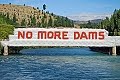
The Clutha River Forum, an alliance of river and conservation groups opposed to "think-big" hydro development on the Clutha, was set up in 2009. It launched a "Option 5 - no more dams" campaign.
Asked for comment about delays to the hydro project, forum co-ordinator Lewis Verduyn, of Wanaka, said the world was changing rapidly "and these former business-as-usual projects are simply not realistic".
"We've always considered further `think-big' dams on the Clutha to be inappropriate, outdated and uneconomic. Now, Contact is facing a landslide of economic and environmental issues that were largely unforeseen just a few years ago.
"With electricity demand falling, the high cost of servicing capital and record low flows in the Clutha River, it's difficult to imagine how these plans could ever be viable in the future," he said.
Contact's stance on the project comes in the wake of the decision last month by Meridian Energy to shelve its plans for a $2 billion wind farm on the Lammermoor Range. Meridian chief executive Mark Binns said shelving the Project Hayes wind farm was "a prudent commercial decision", as the company had other higher-priority projects.
Asked at that time if the decision had any impact on the Clutha hydro plans, Contact hydro projects manager Neil Gillespie said the hydro plans were at a different stage from those of Meridian's Project Hayes.
It had a consented project, while Contact had yet to narrow down the options and was "quite some time away" from thinking about resource consents.
Tuesday, January 24, 2012
Contact Undeterred By Hayes Decision
Power companies undeterred by Project Hayes decision
By Lynda Van Kempen, on Tuesday 24 January 2012
Otago Daily Times
In the wake of the Project Hayes decision, it is business as usual for Contact Energy, weighing up options for hydro development on the Clutha River, and Pioneer Generation, looking at small-scale wind farms.
Meridian's decision to shelve its planned $2 billion wind farm on the Lammermoor Range in the Central Otago has had little impact at this stage on Contact and Pioneer's plans.
Contact Clutha hydro project manager Neil Gillespie said the hydro plans were "at a completely different stage to what Meridian was at when it pulled the plug.
They had a consented project.
"We have yet to narrow down the options and decide on a favoured option and we're quite some time away from even having to think about resource consents," Mr Gillespie said.
Contact has been investigating four main hydro options on the upper and lower Clutha, proposing dams at Tuapeka Mouth, Queensberry, Luggate and Beaumont costing between $300 million and $1.5 billion.
The schemes were mooted more than 20 years ago and originated from proposals by Contact's predecessor, the Electricity Corporation of New Zealand.
Ultimately, the Project Hayes decision would have an impact "when we're looking at starting to build, but we're nowhere near that stage", he said.
In the meantime, the company was consulting the community, and analysing options.
The community's views, technical and engineering studies and the effect on the environment were all factors which would be taken into consideration, Mr Gillespie said.
"Nothing's changed for us in what we're doing because of Meridian's decision."
Pioneer Generation chief executive Fraser Jonker said its plans for wind farms were on a vastly smaller scale than Meridian's.
The Environment Court decision in 2009, which cancelled resource consents for Project Hayes, saying the wind farm was inappropriate in an outstanding natural landscape, had influenced the type of wind farm proposals Pioneer had been investigating.
"We would never attempt to place a wind farm in that type of a landscape because it would be too much of hurdle to get it consented. "The projects we have under more investigation at the moment have taken that sort of landscape into consideration," Mr Jonker said.
Pioneer was still talking to several Otago and Southland farmers about the possibility of constructing small-scale wind farms on rural properties, along similar lines to its nine-turbine Mt Stuart wind farm in South Otago.
Friday, January 14, 2011
Energy companies still spilling water
Energy companies still spilling water
By Sally Rae and Colin Williscroft, on Friday 14 January 2011
Otago Daily Times
Meridian Energy is continuing to spill water from the Waitaki hydro system.
Yesterday, spokeswoman Michelle Brooker said a northwest front was forecast this weekend, which would mean more rain.
It was a case of waiting to see what happened and monitoring the situation. Spilling began after Christmas, due to heavy rain.
Yesterday, the Waitaki River was flowing at 800cumecs, compared with 1110cumecs the previous day.
Pukaki and Tekapo were both still spilling and were down to 80cumecs and 150cumecs respectively.
It was intended to reduce that over the next few weeks, but it was all weather dependent, Ms Brooker said.
"If we get a couple of fronts come through and get lots of water, that could be an issue," she said, adding people should still watch for rising lake and river levels.
• On the Clutha River, Contact Energy is still spilling water at the Clyde dam.
Contact generation manager Graham Quinn said 900cumecs of water was being spilled daily. The amount peaked at 1400cumecs on December 28, before it dropped to about 1000cumecs on January 2.
Further rain increased inflows to about 1300cumecs on January 3, Mr Quinn said.
How long water will be spilled would depend on the weather.
A similar amount of water is being spilled at Roxburgh dam.
Monday, November 1, 2010
POWER Struggle
POWER Struggle
Saturday 30 October 2010
The Press
Wild river, a raft, a safety briefing.
Glenn Murdoch, our good natured and we hope responsible guide, goes through the drill. Forward paddle, backward paddle, hold, stop. Drambuie for everyone if you lose your paddle.
Then he gives us the worst-case scenario. This is when the raft capsizes with the crew in the river and not necessarily attached to the boat.
"Keep your legs in front of you and your head looking down the river," he instructs.
The chances of tipping our bulky craft seem remote to a rookie like me but Murdoch, I guess, has to go through the motions like a flight attendant giving a spiel about the aircraft crashing.
We are on the Mokihinui River, which is in a remote northern corner of the West Coast, about 40 kilometres north of Westport. The launching point for our expedition is well inland, just below the fork in the river where the North and South branches meet and just above the 16km Mokihinui Gorge.
If state-owned Meridian Energy wins the day, most of the gorge will flooded up to an 85-metre dam to be built about 15km from the river's mouth. The resulting 14km-long lake will inundate 225 hectares of pristine lowland forest and obviously the stretch of wild river we hope to travel.
Meridian has the project on first base by obtaining the required resource consents from the West Coast Regional and Buller District councils. In March, commissioners decided, two to one, to grant the consents. The Department of Conservation (DOC), Forest & Bird and Whitewater NZ are appealing and the Environment Court is expected to hear the case in 2012.
Forest & Bird field officer Debs Martin, who is sharing a raft with Green Party co-leader Russel Norman (among others), explains Meridian faces another difficult hurdle: for the dam to go ahead, Meridian needs either permission from DOC to flood the land or it needs to acquire the DOC land by swapping it for other land which will provide a net benefit to conservation. Meridian has offered 700ha of land, two blocks of which are in the Mokihinui catchment below the dam.
DOC has completed its evaluation and a draft report recommends a firm "no" to Meridian on all counts. The final decision must be made by the conservation minister.
Martin hopes the area will end up in a conservation park, a process that was "on the table" before Meridian began the consent process.
She accepts the minister could direct the department to withdraw but thinks that unlikely because DOC has thrown "unprecedented" resources at the fight.
It all looks very difficult for Meridian but its Mokihinui project manager, Chris Evans (not on the trip), who has worked on the project for four years, says Meridian will persevere, concentrating for the moment on the appeal. Meridian has withdrawn its DOC flooding application so it can enter more open discussions.
The search for land to satisfy DOC continues, he says: "It's not an easy task when DOC already administers 80 per cent of land on the West Coast."
Back at the river, the launch is getting closer. About 120 people have gathered for a 6.30am start on a dull but mercifully dry morning.
Evidence before the commissioners showed only about 300 people use the area each year. We are certainly going to boost the average.
The event has been organised by the Christchurch White Water Canoe Club, more as a statement than a protest. The assemblage has its fair share of greenies but white water people come in all sorts of political stripes. Norman is the only politician on the trip.
The first step is for the rafts and kayaks to be bundled into nets and slung beneath helicopters for the trip up to the forks. One whitebaiter has set his net in the river just below the very site where the gear and people are loaded. In a scene reminiscent of Apocalypse Now, three helicopters flying neatly behind each other descend in an urgent racket of whining rotors.
The white water people are obviously not keen on the power project. The proposed lake does not stop them using the higher and difficult North Branch of the river but it means they face a dull 14km flat paddle on the descent which is currently broken by numerous boulder- strewn rapids, quieter stretches of green water, sandy beaches, striking rock features and healthy bush.
They concede their kayaks and rafts are not often seen on the river. As the day of our adventure shows, getting kayaks and rafts up the river is a major and expensive exercise.
Although the commissioners saw the loss of white water recreation as a "significant effect" they considered the dam would provide "a more diverse range of opportunities to a much wider group of people".
Hugh Canard, a Christchurch economic development and tourism consultant, whose heroic organisational abilities make the Mokihinui statement such a success, doesn't buy that argument.
He likens his white water colleagues to the endangered blue ducks who will be supplanted by the dam lake.
"We have the same rights as anybody else. Numbers shouldn't come into it. We are saying we are the blue ducks who have been using the river and minding their own business. Then along comes whoever and wants to take it away. You're going to displace blue ducks and introduce mallards."
While a lake would no doubt increase patronage of the area, by that logic a gondola up Aoraki/Mt Cook would be fine because it would do the same thing for the mountain, he says.
In his view the commissioners overlooked that the Mokihinui is one of only three reasonably accessible rivers on the West Coast that can be used by the majority of competent kayakers.
People who want a lake experience on the coast are spoiled for choice with about 100 naturally formed lakes that are under-utilised, he says.
Canard, 68, who has been kayaking since his late 30s, worries the lake will end up like Lake Dunstan at the head of the Clutha Dam - "dead".
"In my lifetime I've seen one river after another either getting diverted, drained or dammed. We've only got 20 per cent left. That's why the Mokihinui is important."
Tuesday, August 17, 2010
Ruling Revives Wind Farm Plans
Ruling Revives Wind Farm Plans
By Paul Gorman, on Tuesday 17 August 2010
The Press
A South Island wind-power plan that could generate enough electricity for Christchurch and Dunedin has been revived.
Meridian Energy's proposed 176-turbine Project Hayes wind farm in Central Otago is back in the picture after the High Court allowed an appeal against a court ruling that overturned resource consents because of environmental effects on the unique landscape..
The state power company wanted the High Court to quash last November's Environment Court decision, but Justice Chisholm and Justice Fogarty decided yesterday that step was too unusual.
They determined Judge Jon Jackson in the Environment Court had wrongly applied parts of the Resource Management Act (RMA) to throw out consents for the wind farm, of up to 630 megawatts, that had been issued by the Central Otago District Council and the Otago Regional Council.
The High Court has instead set out specific directions for the Environment Court to reconsider the case, much of which hinged on alternative locations for a wind farm and a "test" that Meridian argued the Environment Court had developed which would require it and every other power company to prove projects were better than all alternatives.
Meridian chief executive Tim Lusk said last night the court decision was a "positive" result for the proposed wind farm on the Lammermoor Range northwest of Dunedin.
"We are really delighted and we will now be taking time to consider the report and its implications in the coming days," he said.
Central Otago opponents of the project were disappointed by the decision and hinted that there was only a faint chance of an appeal.
Landscape artist Grahame Sydney said the decision was "disappointing in the extreme".
"This is what Meridian always declared they would do – they would just keep spending money until they got their way. We haven't got any money," he said.
"This is in no way a consent being given. That was never in the High Court's power."
Poet Brian Turner said Meridian was continuing to use taxpayers' money "to batter us".
"They exhaust the life out of us – emotionally, intellectually and financially. It's like a war of attrition," he said.
"We have heard Meridian will go on to the bitter end."
Save Central co-ordinator Graye Shattky said the group, which appealed against the original consents to the Environment Court, needed to study the judgment before deciding whether to take it to the Court of Appeal.
If Project Hayes goes ahead it will be the first major South Island power station built since Contact Energy's 432MW Clyde Dam on the Clutha River in the 1980s.
New Zealand Wind Energy Association chief executive Fraser Clark said the High Court judgment sent a signal to all sectors involved in national infrastructure.
"It will certainly be received positively," he said.
"We are managing this winter well, but it was only a couple of years ago we were in a totally different situation and bringing higher-cost power from the North Island to the South Island."
The High Court hearing was held in Dunedin in June.
In the judgment, Justices Chisholm and Fogarty said they were "troubled" by the wider implications of the Environment Court's approach and that the "reasonable" alternatives the court was expecting would not be restricted to the Central Otago council's district.
"We do not think that Parliament intended that applicants could be called upon to describe alternative sites beyond the relevant district," they said.
"For a company like Meridian seeking a major wind-farm site in the South Island – because the bulk of its customers are located in that island – a comparison of alternative sites in the North Island would be largely meaningless."
The Environment Court was wrong to apply part of the RMA as requiring "explicit and comprehensive" cost-benefit analyses for alternative locations, the judgment said.
The High Court directed the Environment Court give Meridian "reasonable opportunity" to present more evidence on the matter of alternative locations within the district and allow respondents the chance to reply.
Thursday, June 24, 2010
`Financial Burden' On Objectors
Rehearing further `financial burden' on objectors
By Lynda Van Kempen, on Thursday 24 June 2010
Otago Daily Times
A rehearing of the Project Hayes case would impose a further financial burden on groups and individuals objecting to the wind farm, their counsel told the High Court yesterday.
Justices Lester Chisholm and John Fogarty have been hearing the appeal by Meridian Energy, the Central Otago District Council and the Otago Regional Council against the Environment Court's decision declining consents for Project Hayes.
Parties were asked, if the appeal was successful, whether they preferred a rehearing by the same or a different division of the Environment Court, or a reconsideration of the case by the Environment Court.
Justin Smith, who appears for the majority of the objectors, including two environmental groups, said the societies had already incurred a financial burden and a rehearing would add to that.
Justice Chisholm said the usual procedure, if the matter went back to the Environment Court, would be for the same section to consider it again.
If it was sent back for a re-hearing, the financial burden on objectors would probably be greater than any costs which might later be awarded, Mr Smith said.
Alastair Logan, appearing for the two councils, said he had no instructions about which course of action they would prefer.
Counsel for Meridian, Hugh Rennie, said his client sought whatever would give a "fair and just outcome", but it would be better if a different division considered it.
Landscape Seen As Issue On Final Day
Landscape seen to be the issue on final day
By Lynda Van Kempen, on Thursday 24 June 2010
Otago Daily Times
Lammermoor Range, site of proposed wind farm. The value of the Lammermoor Range landscape dominated much of the discussion on the final day of the main appeal against the Environment Court's Project Hayes decision in the High Court at Dunedin yesterday.
Although landscape issues were not included in Meridian Energy's grounds for appeal against the decision declining consents for a 176-turbine wind farm, the topic was raised often in yesterday's submissions.
Meridian is asking for the Environment Court decision to be quashed, and its stance is supported by the two authorities who gave consents for the wind farm: the Central Otago District Council and Otago Regional Council.
The three-day hearing of the main appeal finished yesterday, and Justices Lester Chisholm and John Fogarty have reserved their decision.
Justice Chisholm said a decision on the case, which involved "difficult issues", would be issued as soon as possible.
A cross-appeal by Roch Sullivan, on the Project Hayes decision, will be heard today in the High Court at Dunedin.
Counsel for most of the wind-farm objectors, Justin Smith, said the Environment Court hearing was fundamentally a landscape case.
"The court's findings on landscape values are the backbone of the court's decision," he said.
Meridian's counsel Hugh Rennie said landscapes were not the central issue.
The main issue was a new test, imposed by the court, which set an impossible hurdle for any new development.
It required applicants to consider alternative sites, to the extent of providing a cost benefit analysis.
Contrary to what the respondents said earlier in the appeal hearing, Meridian had provided expert evidence on alternative sites, Mr Rennie said.
The Environment Court had spent much time assessing whether the wind-farm project was an efficient use of resources, but consent was not declined because of the court's findings on efficiency matters, Mr Smith said.
"It was declined because of findings of exceedingly high landscape and heritage values, which were not displaced by findings on efficiency."
Providing details about alternative sites and proposals was not a novel obligation, Mr Smith said.
When an applicant was looking at alternative sites when seeking resource consent for a discretionary activity, it could rapidly descend into a fine-grained analysis, Justice Fogarty said.
Any proposal in a rural landscape was likely to cause adverse effects, he said.
"Every site is going to be a kaleidoscope of good things and bad things," he said.
Comparing two sites could become a sophisticated exercise, he said.
"Where does it end?"
Wednesday, June 23, 2010
Reason For Hayes Ruling Ignored
Reason for ruling ignored, say respondents
By Lynda Van Kempen, on Wednesday 23 June 2010
Otago Daily Times
Meridian Energy had ignored the fact the Environment Court decision on Project Hayes was about the protection of a nationally important landscape from an inappropriate development, the appeal hearing was told yesterday.
Counsel for most of the respondents, including the Maniototo Environmental Society and the Upland Landscape Protection Society, Justin Smith, said Meridian's appeal was based on "peripheral" issues.
He said Meridian's submission to the appeal hearing, in the Dunedin High Court this week, did not recognise the Environment Court's finding that the national economic benefits of the wind farm were outweighed by the adverse impact of the project on the outstanding natural landscape of the Lammermoors.
Meridian could have presented alternative wind farm sites for consideration, but did not do so.
"They said 'Trust me, this is the best'," Mr Smith said.
The Environment Court was seeking some comparison to see whether there were enough benefits in the Lammermoor Range site to justify imposing the adverse effects on the landscape, but Meridian did not provide any detailed comparison with other sites.
The energy company had failed to recognise the site was an outstanding landscape, he said.
The respondents continue their submissions today.
Saturday, June 19, 2010
Wind-Farm Battle To Resume
Wind-farm battle to resume
By Lynda Van Kempen, on Saturday 19 June 2010
Otago Daily Times
The next round in the battle to decide whether the southern hemisphere's largest wind farm should be constructed on the Lammermoor Range in Dunedin starts on Monday.
Five days have been set down for Meridian Energy's appeal against an Environment Court decision declining consents for the proposed $2 billion Project Hayes wind farm.
Justices Chisholm and Fogarty will preside over the hearing in the High Court at Dunedin and only points of law can be addressed in the appeal.
Any party unhappy with the result of the hearing can appeal the decision to the Court of Appeal.
Meridian planned a 176-turbine wind farm on 92sq km of land, making it the largest in the southern hemisphere with the capacity to produce about 630MW of energy each year: enough to power about 263,000 average homes.
In 2006, Meridian lodged resource consent applications for Project Hayes with the Central Otago District Council, and the following year with the Otago Regional Council.
Several individuals and environmental and recreational groups opposed the consents being granted and appealed to the Environment Court.
The 350-page Environment Court decision was released last November.
The court said the negative effects of the wind farm on the landscape, heritage and recreation outweighed the positive benefits to the region and to the country of providing a large quantity of renewable energy.
The court found the project was inappropriate in such an "outstanding natural landscape" and said it was extraordinary that no cost-benefit analysis had been done on the project.
Meridian's "failure to consider alternatives properly" was another factor towards declining consent the court decision said.
Parties involved in the hearing next week include the Central Otago District Council, Otago Regional Council, the Maniototo Environmental Society, Upland Landscape Protection Society, John, Sue and Andrew Douglas, Eric and Cate Laurenson, Ian and Sarah Manson, Gaelle Soguel Dit-Piquard, Ewan Carr and Roch Sullivan.
Wednesday, November 11, 2009
Hayes Ruling ‘Common Sense’
Clutha Groups - Hayes Ruling ‘Common Sense’
Clutha River Forum, on Wednesday 11 November 2009
Groups opposed to further large dams on the Clutha River have praised the Environment Court’s decision declining Meridian’s consents for a $2 billion wind farm on the Lammermoor Range.
Members of the Clutha River Forum, an alliance of community and conservation groups, believe that the ruling, released last Friday, represents “common sense.”
The Chairperson of the Beaumont Residents Group, Neville Hills, saw it as “Finally some common sense for New Zealand.”
“The court’s decision points in the right direction,” says Dr. Richard Kohler, Chairperson of the Central Otago Environmental Society. “This decision is a milestone towards a more sustainable and environmentally friendly future.”
“Common sense should have prevailed from the outset,” said Leigh Morris, Spokesperson for the Lower Clutha River Guardians. “It was obvious that the effects of such a wind farm were never going to be minor.”
In October, the Clutha River Forum launched an ‘Option 5 – No More Dams’ campaign, a reference to Contact Energy’s four dam options for the Clutha River, at Luggate, Queensberry, Beaumont and Tuapeka Mouth.
“The Lower Clutha River Guardians can fully appreciate the high level of stress that Project Hayes has caused to those involved,” said Leigh Morris, yesterday. “We hope that the people of Beaumont can also look forward to a day when they, too, can celebrate the feeling of freedom from a large company seeking to make a profit at the expense of their environment.”
Forum members were critical of past decision-making, recalling the Clyde dam episode. They said that power companies have long regarded the South Island as an endless resource to be exploited, despite the infrastructural costs of sending the power north, and the destruction of prized Southern environments.
Contact Energy is the next in line, with their decision on a preferred option expected within months.
“‘Think Big’ is dying here,” says Lewis Verduyn, Chairperson of the Clutha Mata-Au River Parkway Group. “It has raised its head too often. We have learned that the price is too high. There is a strong economic argument for us to protect our most valued landscapes, and there’s a poor argument to destroy them in order to satisfy the energy demands of the north.”
“Renewable energy production should be located closer to the end user,” says Tim Ryan, Chairperson of the Upper Clutha River Guardians. “The Otago region already has its fair share of power stations.”
The Environment Court drew attention to Meridian’s lack of information on alternatives.
The Clutha River Forum believes that New Zealand is not short of “sensible energy options,” including “offshore wind farms that are closer to the demand than Central Otago, and the immense potential of Cook Strait tidal power now being developed by Neptune Power.”
The Hayes decision,” says Lewis Verduyn, “has not only lifted the consenting bar, it has lifted the spirits of those who cherish this landscape.”
“Now that the clouds of uncertainty have been blown away, the Lammermoor Range will look even better,” said Leigh Morris. “We are thankful for the hard work and effort put in by those who fought against its desecration.”
Tuesday, November 10, 2009
Clutha Hydro Less Likely After Decision
Clutha hydro less likely after decision: mayor
By Lynda Van Kempen, on Tuesday 10 Nov 2009
Otago Daily Times
Further hydro development on the Clutha is now "less likely" than before the Project Hayes decision, Central Otago Mayor Malcolm Macpherson says.
The Environment Court decision declining Meridian's consents for a $2 billion wind farm on the Lammermoor Range was announced on Friday.
The 350-page document said the detrimental impact of the project on the landscape outweighed the positive factors.
The ruling had lifted the bar for consents for renewable energy projects nationwide, Dr Macpherson said yesterday.
"The Clutha hydro schemes will probably be one of the next major renewable energy schemes before the [Central Otago District ] council for consent, when Contact makes up its mind which options it prefers," Dr Macpherson said.
The cumulative effect of developments was a factor in the Project Hayes decision and Meridian had been criticised for not providing more information on alternative sites.
"As a result, it is my opinion that further hydro development on the Clutha River is now less likely than it was prior to this decision," Dr Macpherson said.
"The cumulative effects argument against further hydro on the Clutha will also be strengthened as a result of this decision.
"Because large energy projects were nationally significant, the area relevant to `alternative options' discussions becomes all of New Zealand. That sets a very high threshold".
His comments were echoed by Meridian spokesman Alan Seay.
"One of the issues arising is that it has certainly lifted the bar quite considerably for consenting major renewable energy projects and that's something the country as a whole has to come to grips with," he said.
It would make the last government's targets for this country's use of renewable sources of energy "extraordinarily difficult to achieve".
"We need to turn our mind to what this means for the future of renewable energy in New Zealand."
Mr Seay said the implication was that it might be easier to return to greater reliance on fossil fuels.
Dr Macpherson said, with the benefit of hindsight, he would have preferred the Project Hayes decision go straight to the Environment Court.
"For a similar case, I wouldn't advocate a local hearing first. We thought a local panel [hearing the consent] would protect local values, but that was a little naive because, of course, it became a national debate."
The council was likely to face future decisions about similar large-scale energy projects.
"I have no doubt about that. Central Otago is energy central as far as the rest of the country is concerned."
Saturday, November 7, 2009
Frankly My Dear, We Don't Want a Dam, Either
Project Hayes: Gone with the wind
By Rosie Manins, on Saturday 7 Nov 2009
Otago Daily Times
"It was an inappropriate scheme in an inappropriate place and I always felt that the bench would recognise that."
That was Project Hayes appellant Grahame Sydney's reaction yesterday to the Environment Court's decision to uphold an appeal against Meridian Energy's proposed $2 billion wind farm on the Lammermoor Range in Central Otago.
In a 350-page decision released to parties yesterday, the court refused consents for Project Hayes.
It came nine months after the 33-day appeal hearing for the proposed development had been adjourned in Queenstown.
Mr Sydney, who lives in Central Otago and is an ardent campaigner for the protection of its landscapes, said he had remained confident Project Hayes would be refused since Meridian first applied for consents in 2006 and 2007.
"The common sense and logic was all swinging our way," he said.
Mr Sydney celebrated at St Bathans with friend and fellow appellant Graye Shattky.
"This is right up there with the best times of my life. You have your children and then you have a win like this," he said.
Mr Shattky said it was not everyday he "felt 21 again".
"It's a magnificent day for Central Otago," he said.
Both said the appeal had always been about the landscape, and not energy, and set an important precedent for further proposals of large-scale development in Central Otago.
"This judgement has wonderful repercussions, and could be said to be putting a stop to the desecration of these landscapes in one blow," Mr Sydney said.
Mr Shattky said the Central Otago District Council - which granted initial consents for the project - had no choice but to better protect the district's landscapes of significance.
"The bar has been raised. It leaves the council under no illusion about the responsibility it has to identify and protect the district's special sites in perpetuity," he said.
Former All Black hooker Anton Oliver said he had been in touch with fellow protesters all day, celebrating the news.
"What this result is saying is that some things aren't measured in monetary terms," he said.
"It's saying that some landscapes in New Zealand are so special that you can't put any price on them."
The decision to refuse consents was made by a three-to-one majority.
Environment Court judge Jon Jackson, commissioner Heather McConachy, and deputy commissioner Ken Fletcher agreed the negative effects of the development outweighed its benefit, while commissioner Alex Sutherland dissented.
In the decision, Dr Sutherland said he agreed with and contributed to the writing of most of the document, but in his view the benefits proposed by Meridian were slightly more significant than adverse effects posed by appellants "such as to be in Meridian's favour".
But the final conclusion found key reasons for refusing consents, including the detrimental impact Project Hayes would have on a unique landscape, the fact there could be other potential sites for wind-farm development, and because insufficient evidence was provided by Meridian and the Crown in regard to the efficient use of the site's natural and physical resources.
"After weighing all the relevant matters . . . we judge that the Meridian project is inappropriate in the outstanding natural landscape of the Eastern Central Otago Upland Landscape, and does not achieve sustainable management of the Lammermoor's resources. That is principally because the nationally important positive factors of enabling economic and social welfare by providing a very large quantity of renewable energy are outweighed by the most important adverse consequences," the decision stated.
Costs were reserved, but the decision stated "our current view is that costs should lie where they fall".
Hayes Ruling Knifes 'Think Big' Power
Wind farm ruling may set trend
By Rosie Manins, Saturday 7 Nov 2009
Otago Daily Times
The Environment Court's decision to decline Meridian Energy's controversial Project Hayes wind farm on the Lammermoor Range could spell the end of large-scale electricity generation development in Central Otago, Mayor Malcolm Macpherson said yesterday.
While he had not seen the 350 page decision, he assumed the main reason for declining consent was the special landscapes.
"And if that's the case, it might set one of the most important precedents for Central Otago, Otago, and New Zealand. I wonder whether this is the end of big renewables of any sort, in this part of the country, at least."
Project Hayes, a $2 billion, 176-turbine wind farm, would have been the largest of its kind in the southern hemisphere, encompassing 92sq km of Central Otago high country.
Dr Macpherson said the "devil is in the detail", and the importance of the 350-page document would depend on what grounds Environment Court judge Jon Jackson and the three commissioners declined consent.
"The real significance will be in the rationale behind the decision. Without seeing it I can only guess that the fact it is 350 pages means it was not a simple `no', and there's been a great deal of thought put into it," he said.
People throughout Otago would have mixed feelings about the project being declined, particularly due to the recession.
"There would have been a prolonged period of construction-related activity that would have been really beneficial across all of Otago, and unless there's another application from Meridian, then that opportunity has been lost.
"There would have been a number of people anticipating for some time the pick-up in work from the project and now their hopes are gone. Having said that, there will also be a large number of people who will think it's a very good outcome and will be looking carefully at what it means for other projects," he said.
Dr Macpherson said the Central Otago District Council would have to "tally up" what it cost to be a party in the Environment Court appeal hearing.
The council, along with the Otago Regional Council, initially consented Meridian's application for the project in 2007.
Dr Macpherson said Meridian covered all costs of the initial hearing, but not the appeal.
He wondered whether Meridian would have "deep enough pockets" or the will to make an amended application.
"Maybe a modified application with different parameters would have been successful."
A win and loss: that was how Otago Regional Council chairman Stephen Cairns summed up the Project Hayes decision.
"You could knock me down with a feather. I am surprised to hear the project's not going ahead," he said.
"Speaking without having viewed that decision, I'd have to say my initial response is that it's a win for those who want to protect the landscape but a loss to the nation of a renewable energy resource."
Mr Cairns said he "wouldn't have been disappointed" if the wind farm application had succeeded, and canning the project would be a loss to the country.
"It was a renewable energy resource which had a synergy which made it more than just a straightforward wind farm application."
The issue had certainly divided the region, he said.
"It's been a contentious issue, with people strongly in support of the project, and strong opposition. The only other issue I can think of that has generated such a response in this region in recent times is the [Forsyth Barr] stadium debate."
Friday, September 25, 2009
Meridian Step Closer To Waitaki Project
Meridian Gets Water Rights for N.Z. Hydro Project (Update1)
By Gavin Evans, Friday 25 Sept 2009
bloomberg.com
Meridian Energy Ltd., New Zealand’s biggest electricity generator, was given approval to take more water from the Waitaki River to build the country’s largest hydro-electric project in more than 20 years.
The Environment Court has granted conditional water rights for an underground, 260-megawatt power station on the north bank of the Waitaki River, government-owned Meridian said today. Land-use and construction approvals are still required and an investment commitment is not likely until 2012 at the earliest, Chief Executive Officer Tim Lusk said in an e-mailed statement.
Power companies including Meridian and Contact Energy Ltd. are building wind farms and drilling steam fields to meet rising demand after a shortage of gas and community opposition to dams slowed generation investment. Contact is seeking support for another dam on the Clutha River on the nation’s South Island.
“The decision is very comprehensive, so our next step is to work through it carefully to better understand it and its implications for the project,” Lusk said. Approval remains subject to addressing some issues around wetland and birdlife management, he said.
Meridian operates eight power stations in its Waitaki catchment southwest of Christchurch. It has been working on the North Bank plan since 2005, after abandoning a larger project on the same river a year earlier because of planning delays and public opposition.
The project, estimated to cost NZ$900 million ($648 million) in 2005, would draw water from behind one of the company’s existing dams down a 34-kilometer (21-mile) tunnel to an underground power station.
If completed it will be the largest hydro project since the 432-megawatt Clyde dam was opened in 1992. It will produce enough power to supply Christchurch, a city of 369,000 people, Meridian said.
Wednesday, September 23, 2009
Rio Tinto Recommends Asset Swaps
Rio Tinto Recommends Asset Swaps Among New Zealand Generators
By Gavin Evans, Tuesday 22 Sept 2009
bloomberg.com
Rio Tinto Alcan, New Zealand’s biggest power user, has recommended that the government consider swapping assets among state-owned generators to increase competition and provide more secure year-round supplies.
Swapping some of Meridian Energy Ltd.’s dams on the Waitaki River with Genesis Power Ltd.’s gas-fired plants would improve each company’s geographic spread and provide better incentives to manage the risk of low rainfall, Rio’s New Zealand unit said in a submission. Meridian’s contract to supply Rio’s Tiwai Point aluminum smelter would not have to be transferred, it said.
New Zealand’s government is considering measures to stem a 79 percent increase in household power costs since 2000. Wholesale prices reached a record in June last year, the third time in eight years that consumers were asked to reduce consumption because of low water levels in lakes that usually generate about 60 percent of the nation’s electricity.
Rio Tinto “is open to discussions with the government on a further asset split in the South Island,” New Zealand Director Paul Hemburrow said in the company’s submission.
The 350,000 metric ton-a-year Tiwai Point smelter is 79 percent-owned by Rio Tinto and uses almost 15 percent of the country’s electricity. It is supplied by Meridian Energy, with most of its power coming from the company’s 850 megawatt power station at Manapouri.
Energy Minister Gerry Brownlee last month dismissed two asset-swap proposals among state-owned generators recommended by a review panel and said the government would need to be convinced of the merits of a third.
Security of Supply
None of the three options considered by the government would increase competition on the South Island and may actually reduce security of supply, Rio said.
It advocated transferring Meridian’s Benmore, Aviemore and Waitaki power stations in exchange for two gas-fired generators Genesis runs at its Huntly site on the North Island.
Leaving Meridian with the Manapouri, Tekapo and Ohau power stations would give it sufficient capacity to retail energy on the South Island and still meet its obligations to the smelter contract, Rio said. Each of the companies would also have an incentive to contract or build new plants to meet peak demand.
The government’s diesel-fired emergency generator at Whirinaki should also be sold or transferred to one of the state-owned power companies, it said.
Friday, February 6, 2009
An Abundance of Power Projects
Meridian programme to boost economy, employment
Monday, 2 February 2009, 8:01 am
Press Release: Meridian Energy
State-owned power company Meridian Energy is set to provide a major boost to economic activity and local employment as its billion dollar-plus development programme gathers pace. Chief Executive Tim Lusk says as the company approaches the first-power milestone at its world-leading windfarm project on Wellington’s west coast, it is looking to gear up for a series of major new construction projects. They include the Te Uku windfarm project – a 64-megawatt (MW) development near Raglan which has received planning consent – and up to four other large windfarm or hydro projects which are expected to emerge from the consenting process over the course of the coming year. “Our West Wind project on the hills behind Wellington is a prime example of the kind of projects we will be undertaking. These are large-scale developments, worth hundreds of millions of dollars each and which employ large numbers of local contractors and staff. “West Wind has been a challenging project with its difficult terrain, and the need to ship large pieces of equipment to the site over Cook Strait But it has been a superb demonstration of how you can bring engineering know-how and good old-fashioned Kiwi ingenuity to bear to achieve a great result.
Mr Lusk says first power will be generated at West Wind in mid-April, and the whole 142 MW project, which will power the equivalent of 70,000 average homes, will be fully on stream by the end of the year. “While we are completing that project, we expect to be getting under way at Te Uku mid-year. In addition we expect to receive consent for the Central Wind project in the central North Island, and possibly also Mill Creek, another large-scale wind farm near Wellington.” Meridian also has the 630 MW Project Hayes windfarm project in Central Otago before the Environment Court, is expecting an initial decision on the Mokihinui hydro project on the West Coast, and has received initial consent for its planned tunnel-based hydro project on the North Bank of the lower Waitaki River. As well as providing employment and other economic benefits in the construction phase, Meridian’s renewable energy projects will be a major asset for New Zealand as it seeks to secure reliable electricity supplies for future economic and social development, Mr Lusk says.
Postscript: Friday 30 January 2009
The Green Party's West Coast-based MP Kevin Hague today lodged a submission in support of a proposed hydro scheme on the Stockton Plateau. Hydro Developments Ltd has applied for consent to divert water contaminated by mining from the Stockton area into reservoirs and tunnels that will use a 500m drop to sea level to generate approximately 240 gigawatt hours per year. "The scheme can power more than 30,000 homes," Hague says "and the Stockton Plateau is heavily modified by coal mining operations so the reservoirs have a small ecological footprint. Diverting polluted water will actually improve water quality in the Ngakawau River. "This is in contrast to Meridian Energy's proposed hydro dam in the nearby Mokihinui River that would irreversibly impact rainforest and river species. The Stockton scheme shows we don't need to damn the Mokihinui to satisfy local electricity demand. It completely undermines Meridian's argument. "Damning the Mokihinui in the face of environmentally-positive alternatives like the Stockton proposal would be bloody-minded vandalism. Meridian should withdraw its proposal which is now patently unnecessary and I invite West Coast Tasman MP Chris Auchinvole to join me in this call."
FreeTheClutha says: Two other Meridian projects are wrought with issues: Project Hayes is of a scale and character that would impose major negative impacts on a landscape with unique natural values. The Waitaki tunnel project would divert scarce water from an already impoverished catchment where water is increasingly sought for irrigation schemes by local farmers who deserve to be considered first.
Wednesday, September 3, 2008
Destructive Lust For Power
Destructive lust for power
Wednesday, 3 Sept. 2008
Opinion, Richard Reeve
Otago Daily Times
Does the answer to our future energy needs lie in industrial-scale wind farms or giant hydro projects? Neither, argues Richard Reeve.
A recent question asked of many Otago wind farm opponents is, would they prefer giant hydro on the Clutha to wind farms?
The question is sometimes intended rhetorically as a taunt: what alternatives do we have? Dams on the Clutha have historical notoriety, and the industrial wind farm option is insinuated, rightly or wrongly, as a palliative to more giant hydro such as created Lake Dunstan.
The answer is no; none of the present giant and irreversible Renewable Energy initiatives proposed for the South Island are preferable or indeed necessary.
Irrespective of what schemes for new generation are proposed, New Zealand's energy crisis will be perpetual so long as no serious efforts are being made to recognise and understand the stem of the whole problem, which is our inability to control our own consumption.
Unless we address escalating consumption, the present allocation of energy to different sectors of society, and our gridlock dependency on large-scale generation solutions, in the year 2108, while teenagers are zipping across Dunedin's once-nested beaches on the latest electric trail bikes, we will still be debating where to put new solar farms, which bays to put tidal turbines in, what ridges to flatten for wind farms and whether to dam again.
There is no solution to New Zealand's energy needs that relies on the irreversible devastation of natural landscapes, sea and rivers.
This is because the problem is inherent in our culture, rather than in mere constraints on development related to putting these resources to use.
Successive New Zealand Governments suggest development schedules with a projected future of the next two to three decades, ignoring the consequences of these schedules a century later; yet the legacy of 19th-century colonial imperialism is a cornerstone of our environmental history now.
As a nation, we pretend that we understand ourselves, disregarding the blind spots in historical self-awareness examined by 20th-century philosophers of history as diverse as Hans-Georg Gadamer and Karl Popper.
What Meridian, TrustPower, Contact and others are proposing as essential development will in numerous instances look like rushed, irreversible destruction to future generations, who will regret our recklessness just as we regret the clear-felling of the giant kauri forests or the slaughter of whale populations for oil.
Protecting future generations from these blind spots means carefully thought-out integration of renewable energy, with the intention of minimising irreversible impact.
Where this is not presently possible, with companies insisting on economies of scale as the only way to justify new generation economically, New Zealand must make it happen.
We need small wind farms, more distributed and municipal generation, and no Mokihinui or Clutha dam.
If giant wind farms are built at all, they should be constructed out to sea.
In this respect, the Government's recent national policy statement on renewable electricity generation is commendable in appearance at least, though there can be little doubt that "reversibility" will become the new "sustainability", a word gutted of its original meaning for business councils to flop about like a toy in front of politicians.
Both Mahinerangi wind farm and the Wairau hydro tunnel are regarded by TrustPower and Infratil as "reversible", "sustainable" developments.
In the energy mix, the climate change issue cannot be ignored.
It is a worthy ambition to replace carbon-emitting thermal with renewables, but not where the renewables option is extrapolated as essentially good to the point where irreversible local detractions are regarded as a viable trade-off.
Hydro and giant wind have both been touted as climate-friendly, notwithstanding the fact that 2008 demonstrated clearly that there are extended periods when the lakes are low and there is very little wind, necessitating some form of reserve baseload generation.
Currently, other than hydro, this baseload is thermal and geothermal.
With any transition to electric transport, this baseload will need to increase significantly, and no combination of hydro and intermittent wind will sustainably meet the rise in demand occasioned by such a change.
In fact, reliance on too much wind generation will merely result in more reserve generation being built to accommodate periods like the 2008 drought.
In the present decade, we would be wiser to invest seriously in structural conservation, the practice of "negawatts", rather than building industrial wind farms, though smaller, sensitively placed wind will reduce pressure on hydro.
For the present, we need our thermal reserve generation.
In 25 years, that baseload is likely to come from tidal, geothermal and solar, supplementing our existing hydro and with a variety of wind farms to boot - to wit, those built before the wind-investment bubble burst.
One can well imagine, if the Otago wind farms are thwarted, new environmental conflicts arising with the advent of utility-scale solar in Central Otago, the Mackenzie Country, Nelson and Blenheim, and dolphins being killed by ostensibly benign tidal turbines and pelamis technology.
We should think small, and work generally to diminish the need for new plant being constructed.
Yet, where is the basic demand-side management technology that would allow domestic consumers to monitor the cost of their energy consumption on a real-time basis?
Why do we continue to run worthless lighting in every city in New Zealand, when social security is not an issue inasmuch as adequate illumination is provided by a small portion of the present amount of lighting being run?
Why was Rio Tinto allowed to increase its base consumption of electricity from 554MW to 572MW per annum from 2013? Energy conservation is, like, so 2004.
The greatest service paid to the New Zealand public in terms of domestic energy conservation may, in fact, be by TradeMe, where ordinary Kiwis go to buy secondhand carpet or insulation.
Equally, where are there any serious directives in place to encourage distributed generation or community initiatives for local generation (perhaps three wind turbines for a small town)?
Wind farms do not have to entail intensive development amounting to hundreds of megawatts; nor should ideal wind conditions be the sole determinant of where wind farms will be built.
An intellectual environment has developed in which dubious binaristic distinctions cause dispute among environmentalists whose views and aims are in fact often similar.
There is no choice between giant wind and giant hydro; we may have neither, we may have both.
Either will have irreversible adverse local effects.
Environmentalist opposition to mad energy schemes must face the obstacle of vast legal resources being brought to bear in the Environment Court by businesses with huge budgets.
It doesn't matter that the Mokihinui gorge and Clutha unequivocally trigger RMA issues of national importance, opponents face a highly uneven, uphill battle so long as third-way-style political parties like Labour and National wilfully navigate NGOs and the public as mere obstacles for fundamentally corporate interests.
Richard Reeve is an Otago poet, editor and environmentalist.


