
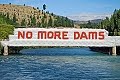
US watchdog kept in loop on dams
By JOHN EDENS in Alexandra, Wednesday 29 July, 2009
The Southland Times
Central Otago conservationists continue to liaise with a United States environmental watchdog about Contact Energy's plans to review four proposals for dams along the Clutha River.
The Clutha Mata-Au River Parkway group, a conservation project opposed to development along the river, has proposed a meeting to discuss the dam proposals. International Rivers, an independent California-based environmental protection group, described Contact Energy's proposals for dams at Tuapeka Mouth, Beaumont, Queensberry or Luggate as potentially "river-wrecking".
At a Vincent Community Board meeting this month Clutha Mata-Au River Parkway secretary Barrie Wills said a meeting was being considered "to gauge opinion for or against" the dam proposals.
Mr Wills said a date or venue for the meeting had not been set but the group continued to liaise with the US organisation.
He said he did not know if International Rivers would send a representative to New Zealand.
Contact Energy's hydro project manager Neil Gillespie said there had been no correspondence with International Rivers or the Clutha group.
Wednesday, July 29, 2009
US Watchdog Kept In Loop On Dams

Wednesday, July 8, 2009
Watchdog says plans 'river-wrecking'
Watchdog says Clutha plans 'river-wrecking'
By JOHN EDENS in Alexandra, 8 July, 2007
The Southland Times
A United States environmental watchdog has attacked plans for dam projects along the Clutha River in Central Otago as potentially "river-wrecking."
Contact Energy announced plans in April to review four proposals for dams at Tuapeka Mouth, Beaumont, Queensberry and Luggate.
International Rivers, an independent California-based environmental protection group, described the proposals, if implemented, as unnecessary and unethical.
Contact Energy hydro development manager Neil Gillespie said the company understood there were groups opposed to more damming in Central Otago.
"The key thing is we have to come to an understanding that hydro is renewable," he said.
In a statement, International Rivers says there is "no practical or ethical justification for further hydro dams on the famous Clutha River".
The Clutha River is a complex environment and existing dams had caused silt problems at Roxburgh and stability concerns at Clyde, the statement says.
The watchdog believes alternative energy sources wind, tidal or geothermal are preferable.
"New Zealand has the best wind energy resources in the world, and yet electricity generation from wind amounts to only two and a half per cent of installed capacity.
"Free flowing rivers like the Clutha are scarce, and offer more recreational and tourism opportunities in their natural state. River-wrecking dams are the wrong choice for a warming world."
Contact Energy expects to announce a preferred development option next year and it will be at least 2015 before construction begins.
An online forum was set up to give communities a voice and Contact was planning to meet interest groups, he said.
Damming can create tourism and recreational opportunities, he said, and the company is also investigating potential sources of alternative energy.
"There are a number of options for future (energy) generation and hydro is one of them. We have a process with the Resource Management Act to address any effects. It's wrong to assume there are no positive impacts," he said.
Beaumont Residents' Group chairman Neville Hills said he had not been in contact with International Rivers.
However, he wondered why anyone would want to ruin something with international appeal by putting a dam on it.
Mr Hills and his wife Vicki could be affected if Contact Energy choose the Tuapeka option, which would result in the township and surrounding agricultural land being inundated. Residents would be relocated, new roads constructed and bridges built.
Mrs Hills said Contact Energy have not met with any Beaumont people.
"It was only last month they sent a letter to the residents."
ENVIRONMENTAL ADVOCATE
* International Rivers' headquarters is in Berkeley, California.
*The non-government organisation has offices in five continents.
*Formed in 1985 and formerly known as the International Rivers Network. Its mission statement is to "seek a world in which rivers and the life they support are valued."
* The organisation works with environmental groups, human rights advocates, policy analysts and climate experts.
*International Rivers was the driving force behind the formation of the World Commission on Dams, which seeks to standardise dam construction worldwide.
* The organisation has worked in more than 60 countries but its focus is in Latin America, Asia and Africa.
Tuesday, July 7, 2009
Global Watchdog Opposes Clutha Dams
Global Watchdog Opposes Clutha Dams
Unabridged statement as released
By Aviva Imhof, Campaigns Director, International Rivers Network,
and Lewis Verduyn, Chairman, Clutha Mata-Au River Parkway Group.
Tuesday, July 7, 2009
International Rivers' mission is to protect rivers and defend the rights of communities that depend on them. We oppose destructive dams and the development model they advance, and encourage better ways of meeting people’s needs for water, energy and protection from damaging floods. To achieve this mission, we collaborate with a global network of local communities, social movements, non-governmental organizations and other partners.
The large dams proposed by Contact Energy for New Zealand’s Clutha River are unacceptable and unnecessary development options.
World-wide, large hydro dams have devastated river ecosystems and the livelihoods of communities that depend on them. Dam projects are often more harmful than alternative forms of renewable generation, especially when placed across the main artery of a river. Having existing dams on a river, is not in itself justification for further dams, as problems are typically magnified as more large dams are added to a river system, resulting in an increased and cumulative loss of natural resources, habitat quality, environmental sustainability and ecosystem integrity.
Some of the worst impacts of global warming on both people and ecosystems will be felt on water and the hydrological cycle. Some areas will become much drier, some wetter. More extreme floods will threaten the safety of dams, and unprecedented droughts will drastically reduce the hydropower and water supply services that dams are built to provide. Minimizing the impacts of climate change will require moving away from a dependence on large dams for electricity generation and flood control.
The proposed dams at Tuapeka Mouth, Beaumont, Queensberry and Luggate are essentially ‘run of the river’ dams with minimal storage that would not contribute greatly to New Zealand’s energy security. New Zealand’s heavy dependence on hydropower, combined with climate change-induced water storage depletion during dry winters, and a complex distribution network spanning the length of the country, are obvious reasons to avoid compounding these issues with further large hydropower schemes.
It is vital to further diversify and decentralize the energy supply. New Zealand is fortunate to have a range of electricity generation options including wind, geothermal, and marine. These, combined with greater efficiencies in areas such as household insulation, have the potential to provide New Zealand with more than sufficient energy in the long-term.
New Zealand has the best wind energy resources in the world, and yet electricity generation from wind amounts to only 2.5% of installed capacity. By contrast, Denmark generates 20% of its electricity from wind, and Spain will generate 15% of its electricity from wind by 2010.
Marine generation also has the potential to be a major contributor of electricity in New Zealand. Cook Strait is an ideal location for marine generation and distribution. Neptune Energy has estimated that 7000MW could be generated in the Strait, which is almost equivalent to New Zealand’s total annual production.
International Rivers also works to address the legacies of existing projects, to improve development policies and practices, and promote water and energy solutions for a just and sustainable world. The Clutha River has proven to be a complex and challenging environment for dams, as evidenced by the serious siltation issues faced by the Roxburgh Dam, and the stability and seismic safety issues faced by the highly destructive and controversial Clyde Dam. There are serious concerns relating to the safety and sustainability of these existing dams.
Further, the long-term acquisition of some 4000 hectares of land for as yet unconfirmed projects has already had a significant negative impact on river communities by stifling local development.
The Clutha River has extraordinary natural, recreational, tourism and cultural values. The Clutha Mata-Au River Parkway Group and the Clutha Gold Trail Trust are two local groups working to protect and improve their river resource. These projects offer highly desirable outcomes from both an economic and an environmental perspective, locally and regionally. Authorities are urged to support local river communities in their river park and trail initiatives.
Forming another artificial lake in a region that already has several magnificent lakes, and removing a large wild river, where there are no other such rivers, is not a logical advantage for recreation and tourism. Free flowing rivers like the Clutha are scarce, and offer more recreational and tourism opportunities in their natural state, especially in the unique and spectacular environment that is Central Otago.
River-wrecking dams are the wrong choice for a warming world. There is no practical or ethical justification for further hydro dams on the famous Clutha River.


