
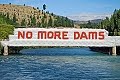
Irrigation prospectus withdrawn
By Lynda van Kempen, on Saturday 29 June 2013
Otago Daily Times
Tarras Water Ltd has withdrawn its second consecutive
prospectus after failing to find a dry shareholder for its
proposed $36.5 million Tarras irrigation scheme and may have
to ''concede defeat''.
The company received a double setback this week when the
Otago Regional Council decided against investing $3.5 million
in the scheme. It had the option to take up 30% of the
''dry'' shares, covering properties which chose not to
irrigate.
Because of the regional council's decision, the Central Otago
District Council's support for the scheme also lapsed. It had
agreed to guarantee a bank loan of up to 20% of the capital
cost of the scheme, but only if the regional council
invested.
The proposal was to draw water from the Clutha River to
irrigate 5999ha of Tarras land. The scheme aimed to ease
demand on the Lindis River. The regional council said the
company had not met council-imposed conditions and the risk
of not being able to on-sell the dry shares meant the
investment was too risky.
Earlier this month, the company withdrew its first
prospectus, after failing to meet its 70% threshold for
''wet'' shareholders. It issued another prospectus with a 65%
threshold for wet shareholders. Yesterday was the closing
date for the latest share offer but it withdrew the
prospectus yesterday afternoon.
''Despite its best efforts, Tarras Water Ltd has been unable
to secure interest from a party prepared to be a dry
shareholder within the current prospectus time frame,'' a
statement from the company's board said.
The company had signalled in the prospectus it needed support
through a dry shareholder, applying for redeemable preference
shares, ''to allow the proposed scheme to be built to
optimise its potential''.
It had explored all the options in terms of dry shareholders,
including considering seeking support from the Crown
Irrigation Fund, but the fund would not be functional until
next month, company secretary John Morrison said.
''Therefore, the TWL board wishes to advise that as at the
closing date for the prospectus, no shares can be allotted as
terms and conditions of this prospectus will not be met.''
Asked yesterday whether the board was ''conceding defeat'',
Mr Morrison said: ''I guess we're conceding, on this
particular scheme.''
The board would be meeting soon to ''take stock of where
we're at'' and consider its options, he said.
The board's statement said ''mindful of its responsibilities
to the Tarras district, the board will now consider its
options, including any subscription cheques or deposits held
by TWL being returned to their owner''.
Mr Morrison declined to elaborate on other options being
considered by the board.
Saturday, June 29, 2013
Irrigation Prospectus Withdrawn

Friday, June 28, 2013
Central Otago Water Scheme Rejected
Central Otago water scheme rejected
Friday 28 June 2013Radio New Zealand
The Otago Regional Council has rejected a request to put money into a Central Otago water scheme and the decision may end the $39 million project.
The Tarras Water Scheme would irrigate farmland in the Ardgour Valley, taking water from the Clutha River to supply 40 properties covering about 6000 hectares in the district which lies between Cromwell and Wanaka.
But council chief executive Stephen Woodhead said on Thursday that the backers of the scheme have failed to meet several council-imposed conditions.
Mr Woodhead said the council was asked to contribute $3.5 million by way of dry shares. But there was a risk they would not be able to sell those shares in the future to recoup costs.
The council also said it couldn't ignore the depth of feeling in parts of the community about the wisdom of the regional council investing ratepayer money in an irrigation scheme or its impact on rates.
A spokesperson for Tarras Water said he is unable to comment until the share offer on the scheme closes on Friday.
Tuesday, June 25, 2013
Call To Reject Irrigation Scheme
Call to reject irrigation scheme
By Rebecca Fox on Tuesday 25 June 2013
Otago Daily Times
Investing in Tarras Water Ltd's proposed irrigation
scheme is too risky for the Otago Regional Council, its staff
say.
They are recommending the council not invest in the $36.5
million scheme. The option was to take up 30% of ''dry''
shares (covering properties which choose not to irrigate) to
irrigate 5999ha in Tarras.
Councillors will make a final decision on the $3.35 million
investment, which had already cost the council about
$250,000, at a meeting in Dunedin tomorrow.
It will end a six-month debate which included the council
controversially overturning a hearing panel recommendation
not to give it the option of investing in the scheme.
The council since had struggled to get the information it
needed from the company to make an investment decision.
In the meantime, Tarras Water had issued two prospectuses,
the second changing the form of the scheme and reducing the
''wet'' share (landowners who take up the option to irrigate)
take-up from 70% to 65%.
In a report to be considered by the council, corporate
services director Wayne Scott said it was very disappointing
Tarras Water had made ''fundamental'' changes to the scheme
without any contact with the council.
''The reissued prospectus moves further from common ground.''
It also meant conditions the ORC had set in its long-term
plan amendment to allow investment were not met by Tarras
Water.
A significant risk was the uncertainty around the council's
ability to on-sell the shares not taken up by landholders, he
said.
The new prospectus raised doubts over landowners having to
buy shares from the council or taking up their full
allocation.
This risk was greater than first assessed and the council was
aware of at least one 100ha property in the area where owners
had installed their own irrigation scheme.
''It is our view that the identified dry shareholder
investment does not appear entirely robust,'' Mr Scott said.
As a result, the council could be left holding dry shares
which would offer no return.
The council had sought independent advice, including a
financial and investment risk report from Ernst and Young, an
engineering review from Beca and advice on its possible
liabilities under the Securities Act.
While Beca reported the scheme was sound, Ernst and Young
advised the scheme was not designed to deliver a commercial
return to shareholders.
It also noted the largest 10 landholders represented 83% of
the scheme area and four of those owned 55%, and the debt
repayment period had been extended to 47 years, longer than
the water permit term of 35 years.
While a return on the council's investment is planned, it
would not be a normal rate of return considering the
associated risks, according to the Ernst and Young report.
The council's support had been based on it being a community
scheme providing water for domestic, stock and fire-fighting
use, Mr Scott said.
As Tarras Water had reduced the scheme's size, it appeared to
be for irrigation only.
The public, through the long-term amendment and annual plan
processes, had shown its opposition to the council funding
the scheme and many who once supported it no longer did
because of the loss of community services.
If the regional council accepted its staff recommendation, it
could put the Central Otago District Council's bank loan
agreement with Tarras Water - up to $8 million, or 20% of the
capital cost of the scheme - into question as it was
conditional on ORC support.
It would also mean the regional council's general rate
increase would only be 2.97%, not the 5.34% proposed if it
went ahead with the Tarras investment.
Tarras Water Ltd chairman Peter Jolly was on holiday in Fiji
and could not be contacted yesterday for comment. Company
secretary John Morrison, who was in Melbourne, declined to
comment as he had not seen the council report, and said
nobody from the company would be able to comment at this
stage.
Tarras scheme • Take water from Clutha River to irrigate land in Tarras.
• Initially proposed to cover 7630ha - now 5999ha.
• Was to include water for firefighting, town and domestic supply - now it will not.
• Cost $36.5m.70% take up of ''wet'' shares amended to 65% after investment fell short.
• ORC to take up 30% of dry shares worth $3.5m.
• CODC to guarantee bank loan if ORC gives its support.
Friday, January 6, 2012
Contact Vies For More Time
Contact vies for more time to establish hydro scheme
By Lucy Ibbotson, on Friday 6 January 2012
Otago Daily Times
Contact Energy has asked for more time to establish a hydroelectric scheme at Lake Hawea, citing the global economic downturn and seasonal construction constraints as reasons for the delay in exercising the project's original consent.
Contact has proposed the construction and operation of a small-scale hydro-generation facility in the outfall control structure of the existing Lake Hawea dam.
It secured an original land use consent from the Queenstown Lakes District Council in 2007 for the 17.2MW Hawea Gates Generation Project, due to lapse on February 7.
Contact also holds associated consents granted by the Otago Regional Council with expiry periods of 10 and 15 years, lapsing on various dates in 2017 and 2022. It wants to extend the expiry date of the QLDC consent another five years, to July 16, 2017, to coincide with the regional council consents.
Contact hydro-development project manager Neil Gillespie said, while Contact was "continuing to progress, giving effect to the consent", it was not possible to complete the final design and construction of the project within the current QLDC consent period.
The extension application said a combination of "technical, practical and economic constraints" were behind the delay.
The project was not straightforward as it involved "retrofitting a modern tailor-made generation plant to existing infrastructure", making the economic risks of project high, the application stated.
A final investment decision could not be made by the current lapse date, a situation "exacerbated by the global economic downturn and associated slower-than-anticipated growth in electricity demand since 2008".
Also, because initial construction work had to be performed "in-river", the project was limited by the ORC consents and seasonal constraints, which had contributed to its extended duration.
The project requires modifying the Hawea dam structure, on Contact-owned land, by constructing twin powerhouses; installing a generation plant; altering the intake structure; installing penstocks through the existing sluices; strengthening some existing works; and carrying out earthworks and upgrades to access roads.
Mr Gillespie said the extension would help achieve the objectives of the QLDC district plan and was an efficient and sustainable use of the resources.
"It's a great little project, renewable, small scale, and makes the most of an untapped resource, the water already being spilled through the dam.
"Importantly, the development involves no long-term changes to the river environment."
It would take up to 36 months to complete the final design and construction, and the expected timeframe to complete all work is no later than 2017, in line with the current ORC consents.
Contact was "still working through [geotechnical] information" on the four other Clutha River locations identified as options for hydroelectric dams - Luggate, Queensberry, Beaumont and Tuapeka Mouth - Mr Gillespie said.
Saturday, October 29, 2011
New Bridge Uncertainty
New bridge uncertainty
By Matthew Haggart, on Saturday 29 October 2011
Otago Daily Times
Beaumont Bridge. Photo by Craig Baxter. Extending the life of the 123-year-old Beaumont Bridge across the Clutha River is expected to cost upwards of $590,000 during the next five years.
The New Zealand Transport Agency is prepared to pay at least this sum while it deliberates what it might cost to design and build a new structure.
A decision on replacing the bridge may be on the backburner because a hydro dam could be built downstream from Beaumont, flooding the Beaumont Valley.
Contact Energy hydro projects manager Neil Gillespie said the company had not been in consultation with the NZTA about any future structure which might replace the Beaumont Bridge.
If Contact built a dam at Tuapeka Mouth, it could affect the bridge site and State Highway 8 through the area.
Mr Gillespie said Contact had always acknowledged it would have to provide mitigation measures, once a decision was made about the future of any possible hydro scheme.
Over the past five years, about $1.29 million has been spent by the NZTA as it tries to extend the life of the run-down, ageing structure.
The SH8 bridge has been back in the headlines after the NZTA recently denied the structure was unsafe after Waitaki deputy mayor Jim Hopkins questioned whether several safety features were put in place to stop it collapsing.
NZTA southern region director Jim Harland told members of the Otago Regional Council's (ORC) transport committee the bridge was not in danger of falling down.
It was preferable to replace the bridge and the NZTA was still considering its options about when that might happen, Mr Harland said.
NZTA Otago-Southland operations manager Roger Bailey said forecast expenditure to maintain the bridge might vary.
About $28,000 is forecast to be spent each year to maintain scaffolding on the bridge, set up to carry out regular monitoring, structural inspections, testing and minor routine repairs.
About $60,000 is to be spent every year to maintain and repair "surface running boards" on the structure, "which tend to loosen, wear out and crack", Mr Bailey said.
The NZTA also incurred costs of about $30,000 a year in consultants' fees to monitor the maintenance programme, he said.
"If our monitoring identifies any unforeseen structural problems, there would be additional costs that we cannot predict," Mr Bailey said.
NZTA transport planning manager Ian Duncan said it remained cost-effective to continue to maintain the bridge during the next five years.
If any new bridge built was affected by Contact's plans, then the power generator would have to "come to the party", he told ORC transport committee members.
Thursday, February 10, 2011
Missing Man's Body Returned Home
Missing man's body returned home
By Barbara Withington, on Tuesday 10 February 2011
Southland Times
For some it meant closure, others saw it as nothing short of a miracle.
Family members gathered at the Beaumont Jet office yesterday morning as the body of Paul Wilson was bought ashore from the swollen Clutha River, ending seven days of searching since the 28-year-old civil engineer went missing in the Talla Burn stream while collecting water samples.
With the Clutha River flowing at about 1300 cumecs (normal flow about 800 cumecs), dropping from a high of almost 1550 cumecs on Tuesday morning, fears had been held Mr Wilson's body would never be recovered.
In normal river flow, the body of 16-year-old Darryl Walker, who dived into the Clutha River 1km south of Roxburgh on November 11, 2008, was never found.
In a media release, Detective Sergeant Derek Shaw said Dave Crawford, of Beaumont Jet, continued to observe the river and had discovered Mr Wilson's body about 11am.
"We believe Mr Wilson has always been within the search area but had only recently become visible," Mr Shaw said yesterday.
Police also thanked Central Otago LandSar, volunteer searchers, local farmers and Contact Energy, who all assisted in the search.
Mr Wilson had been the project engineer for Talla Burn Generation, a run-of-the-river power scheme developed by his father Jeff Wilson in partnership with Beaumont Station owner Alan Hore.
The scheme began producing up to 2.6megawatts of power in early November.
One of the conditions placed by the Otago Regional Council on the project was that regular water samples be taken, and it was while he was carrying out sampling of the Talla Burn in flood that Mr Wilson disappeared.
Senior Sergeant Andy Reed, who was involved in the search for and recovery of Mr Wilson, was a neighbour of Mr Wilson's parents but said he felt the loss no more than anyone else.
"Anyone in Roxburgh who has anything to do with the family will be feeling it for them," Mr Reed said.
The matter has been referred to the coroner.
Mr Wilson's family asked for privacy
Tuesday, February 8, 2011
More Flooding For South Otago
More flooding tipped for South Otago
Tuesday, 8th February 2011
Otago Daily Times
The Otago Regional Council is predicting further flooding of rural farmland near Balclutha after heavy rain caused surface flooding in South and West Otago yesterday.
Although many rivers in the area are dropping, the ORC is predicting the Clutha River to peak at around 1900 cumecs at lunchtime today. This means low-lying areas close to the river, up and downstream of Balclutha, will flood, adding to the already high water levels in the lower Clutha delta.
Because Clutha river flows upstream at Roxburgh Dam are above 1400 cumecs, the lower Clutha is expected to remain high for several days.
Saturday, August 21, 2010
ORC Concern Over Dam Safety Rules
ORC concern over dam safety rules
By Rebecca Fox, on Saturday 21 August 2010
Otago Daily Times
The Otago Regional Council does not think dam owners are capable of managing safety under a more relaxed regulatory regime.
A new dam safety scheme, due to have come into effect in July, was delayed to allow for an independent review after concerns about its potential compliance costs.
That review found the scheme was needed but required modifying to improve its efficiency and reduce compliance costs.
It also recommended the definition of a large dam be increased, eliminating an estimated 36% of "low-impact dams" from the requirements of the scheme.
The Department of Building and Housing consulted on the review, receiving 33 submissions, including one from the Otago Regional Council.
It would now analyse the submissions and report back to Government in the next month "or so" with advice on which recommendations should be implemented, a department spokesman said.
The regional council has been the building consent authority responsible for dams in Otago since May 2008 and for dams in Southland and the West Coast from July 2008.
In its submissions on the proposed changes, the council said dam owners had not demonstrated to the council they would be "capable of responsibly managing safety" under a more relaxed regulatory regime.
"Further experience shows that the industry is not meeting regulatory requirements that have existed under the Building Act for almost two decades."
Council environmental engineering and natural hazards director, Gavin Palmer, said in an interview dam safety was very important, as unlike most other structures, the effects of any failure would be felt off-site.
"Its an important issue . . . for anybody who lives downstream of a dam . . . who is thinking of buying property."
At present, there was a "vacuum" in the power available to the council to act if it had concerns about the "integrity" of a dam, although it did if there was immediate danger, he said.
Under the scheme as it stood, dam owners would have had to inform the council of their ownership, but with the proposed reduction in size, there would be no legal requirement for owners of smaller dams to do so.
"It makes it hard to assess the scale of the problem."
As to the suggestion of centralising the dam safety scheme functions, the council only believed it would work if central government took on all the Building Act dam responsibilities.
Otherwise, it was comfortable with the requirements to stay with regional councils.
"It's really important it is done as a coherent whole."
The Department of Building and Housing said the review recommended the authorities administering the dam safety scheme should have the power to deal with risky "smaller" dams.
This power would enable dams that would not otherwise be in the scheme to be managed, he said.


