
Residential lot project application 'test case'
By Mark Price, on Friday 7 June 2013
Otago Daily Times
An application to develop 35 residential lots on 300ha of farmland between Wanaka Airport and the Clutha River was described as a ''test case'', at a Queenstown Lakes District Council resource consent hearing in Wanaka yesterday.
The Upper Clutha Environmental Society was one of seven submitters to the Corbridge Estates Ltd consent application, and called for the number of lots to be reduced by 13.
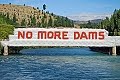
In his written submission to independent commissioners Jane Taylor and Christine Kelly, society president Julian Haworth said the development could set a precedent for further development along the Clutha River and its ''visual amenity landscape''.
The society did not object to 22 proposed houses around two lakes that would be created as a central feature of the subdivision, Mr Haworth said.
But it saw ''no merit'' in another 13 residential lots that had the effect of ''scattering'' development along the river.
Mr Haworth considered these lots were in conflict with the district plan's objectives and the ''Wanaka 2020'' planning document.
He said the developers - Lloyd Ferguson and Peter Marshall, of Wanaka - failed to fully appreciate the adverse effects of the ''clutter'' associated with 35 new dwellings, such as roading, swimming pools, tennis courts, caravans, boats, driveways, accessory buildings, washing lines, lighting and children's toys.
In her submission on behalf of Corbridge Estates, landscape architect Elizabeth Steven said the proposal, ''despite its scale and the consequent degree of landscape change'', would meet ''almost all'' the objectives and policies of the district plan as it related to landscape and visual matters and nature conservation matters.
Planner for Corbridge Estates Duncan White laid out the changes that could occur if the proposed development did not go ahead and the land was more intensively developed for agriculture instead.
The property was now run as a low-input sheep and crop operation, but to make it a more economically viable farming operation it could have new fences, shelter belts, irrigation infrastructure, including pump sheds, cows, deer, machinery noise at any time of day or night, spraying, fertiliser application and animal and silage odour.
''Such an outcome is not fanciful; indeed it is likely and could be achieved under the current rural general [zone] provisions.''
The hearing is expected to conclude today.
Friday, June 7, 2013
Residential Lot Project 'Test Case'

Thursday, June 6, 2013
Farm Subdivision Hearing Underway
Farm subdivision hearing under way
by Jessica Maddock, on Thursday 6 June 2013
Southland Times
A sheep farm near Wanaka will be economically unviable if a proposed subdivision is not given consent, a hearing has been told.
Corbridge Estates Partnership Ltd has applied for resource consent to create 35 sections on its 322ha farm at 707 Wanaka-Luggate highway.
Just over 310ha would remain as a working farm, owned by the residents. A consent hearing began in Wanaka yesterday before independent commissioners Jane Taylor and Christine Kelly.
The applicant's lawyer, Graeme Todd, said the landowners may consider converting to dairy farming if subdivision consent was not granted.
The landowner already had consent for sufficient water for irrigation and, while consent would be required for central pivot irrigating systems, these had been permitted on "numerous other properties" in the district.
Installing such irrigation infrastructure would result in "quite a significant effect", due to the removal of large amounts of vegetation, which also could be done without consent.
Alternatively, the applicant could by right use the land to winter 4500 dairy cows for 10 weeks of the year.
K-line and travelling irrigating systems could also be used without consent. Mr Todd said his submissions were "not standover tactics . . . it is a reality".
The 35 sections Corbridge Estates was proposing to create would range in size from 2150sq m to 10,500sq m. The building platform on each could be up to 1000sq m.
The Upper Clutha Environmental Society was among five submitters who opposed the plans, although Mr Todd said yesterday that agreements had been reached between the applicant and two of the opposing submitters, the Wanaka Airport and a neighbouring farmer, to allay their concerns.
The environmental society proposed reducing the number of lots by 13, to 22, saying the current plan would result in "domestic scattering" to an extent which would be inappropriate in the rural general zone, especially along the Clutha River corridor. This would leave 22 lots around the central man-made lake which is proposed by the applicant.
But Mr Todd said such a change would make the proposal unviable.
"From an economic point of view, it's important this application gets a tick as a whole."
The environmental society's concerns could be dealt with by a clause preventing development on the riverside sections which could be seen from the river corridor, he said.
The application had three neutral public submissions, but none in support.


