
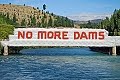
Albert Town hit hardest if dam fails
By Sarah Marqet, on Tuesday 13 August 2013
Otago Daily Times
If the Lake Hawea Control Dam were to fail, up to 420
properties and 2620 people could be affected, a Contact
Energy-commissioned report says.
The September 2011 report outlines potential consequences of
a dam failure and was required as part of the energy
company's standard practice, not because of any concerns with
the dam.
It has been made public now due to its inclusion in the
agenda for the Clutha Management Committee meeting on Friday.
Albert Town, situated at the confluence of the Hawea and
Clutha Rivers, would be the town most affected, with possibly
158 to 230 properties, two hotels and a campsite flooded.
However, providing a breach of the dam was noticed when it
first happened, there would be a three-hour window before the
flood waters reached the town, allowing time for evacuation.
Depending on initial water levels in Lake Wanaka, there could
also be extensive damage through Wanaka town with 60
buildings, including hotels, cafes and a supermarket,
affected.
Because of the large storage capacity of Lake Wanaka, it
would be three days before the peak level was reached.
Three bridges across the Hawea and Clutha Rivers would
probably be destroyed by the flood but the one on State
Highway 8B at Cromwell would not.
The ''flood wave'' travel time from Lake Hawea to the upper
reaches of Lake Dunstan would be seven hours, allowing plenty
of warning time for Contact Energy to increase the flow of
water through the Clyde Dam to lower the level of the lake.
The Clyde Dam is 94km downstream of the Hawea dam.
Water would flow over the top of the Clyde Dam (overtopping)
for up to 26 hours, but it had been designed to withstand
this.
Severe bank and river bed erosion could occur, as could
deposits of debris due to the ''heavily wooded banks''.
The report, by AECOM New Zealand Ltd, used two dam-failure
scenarios - an earthquake-induced failure and a failure
induced by high lake levels following a ''probable maximum
flood event''.
It was the latter failure that would cause the most damage.
The Lake Hawea Control Dam is an earth-fill dam. The report
says failures of that kind of dam are ''extremely rare but
have occurred in the past as the result of internal erosion
or overtopping''.
Tuesday, August 13, 2013
Albert Town Hit Hardest If Dam Fails

Saturday, August 21, 2010
ORC Concern Over Dam Safety Rules
ORC concern over dam safety rules
By Rebecca Fox, on Saturday 21 August 2010
Otago Daily Times
The Otago Regional Council does not think dam owners are capable of managing safety under a more relaxed regulatory regime.
A new dam safety scheme, due to have come into effect in July, was delayed to allow for an independent review after concerns about its potential compliance costs.
That review found the scheme was needed but required modifying to improve its efficiency and reduce compliance costs.
It also recommended the definition of a large dam be increased, eliminating an estimated 36% of "low-impact dams" from the requirements of the scheme.
The Department of Building and Housing consulted on the review, receiving 33 submissions, including one from the Otago Regional Council.
It would now analyse the submissions and report back to Government in the next month "or so" with advice on which recommendations should be implemented, a department spokesman said.
The regional council has been the building consent authority responsible for dams in Otago since May 2008 and for dams in Southland and the West Coast from July 2008.
In its submissions on the proposed changes, the council said dam owners had not demonstrated to the council they would be "capable of responsibly managing safety" under a more relaxed regulatory regime.
"Further experience shows that the industry is not meeting regulatory requirements that have existed under the Building Act for almost two decades."
Council environmental engineering and natural hazards director, Gavin Palmer, said in an interview dam safety was very important, as unlike most other structures, the effects of any failure would be felt off-site.
"Its an important issue . . . for anybody who lives downstream of a dam . . . who is thinking of buying property."
At present, there was a "vacuum" in the power available to the council to act if it had concerns about the "integrity" of a dam, although it did if there was immediate danger, he said.
Under the scheme as it stood, dam owners would have had to inform the council of their ownership, but with the proposed reduction in size, there would be no legal requirement for owners of smaller dams to do so.
"It makes it hard to assess the scale of the problem."
As to the suggestion of centralising the dam safety scheme functions, the council only believed it would work if central government took on all the Building Act dam responsibilities.
Otherwise, it was comfortable with the requirements to stay with regional councils.
"It's really important it is done as a coherent whole."
The Department of Building and Housing said the review recommended the authorities administering the dam safety scheme should have the power to deal with risky "smaller" dams.
This power would enable dams that would not otherwise be in the scheme to be managed, he said.
Monday, August 16, 2010
Call For Regulation On Dam Safety
Call For Regulation For Dam Safety
Monday, 16 August 2010
Radio NZ
Campaigners say tougher regulation is needed to ensure dangerous dams are shut down.
Unlike most other developed countries, New Zealand has no specific dam safety laws.
Regulation was due to come into force in July, but was put on hold by the Government after dam owners raised concerns about compliance costs.
An independent safety review, commissioned by the Government, was subsequently carried out and concluded some dams are neglected and need to be decommissioned.
It found an urgent need for better monitoring, but recommended focusing on large dams to reduce red tape.
Clutha River Forum coordinator Lewis Verduyn says regulation is long overdue and should not be watered down.
He says thousands of people live and work in the hazard path of dams, and it is not fair that dam owners can avoid regulatory oversight.
The chairperson of the Wild Rivers campaign, Debs Martin from Forest and Bird, says it's not just people under threat, but sensitive habitats like estuaries.
She was living in South Canterbury when the Opuha dam collapsed in 1997 discharging 13 million cubic metres of water, causing millions of dollars of damage and killing about 1000 stock.
Ms Martin says decisions about dams are too critical to leave to cash-strapped regional councils and national oversight is needed.
The Department of Building and Housing says the proposed dam safety scheme is about planning to avoid a rare event.
Spokesperson Craig Hill says that, while there has not been any legal requirement for inspections, most large dam owners carry out comprehensive monitoring.
Monday, August 9, 2010
Dam Safety Regime Delay Controversial
Dam safety regime delay controversial
By Colin Williscroft, on Monday 9 August 2010
Otago Daily Times
A Clutha River lobby group worried about way the safety of large dams in New Zealand is monitored is dismayed a proposed new dam-safety scheme has been delayed.
A scheme was due to come into effect on July 1 but was deferred, in the wake of an independent review.
Building and construction Minister Maurice Williamson said the two-year delay would allow time for the review's recommendations to be fully considered and any legislative amendments made.
That drew fire from the Clutha River Forum, which said a national safety scheme was long overdue and until one was implemented, large dam safety in New Zealand depended on the public having "blind faith" in dam owners.

"They do their own inspections and there is no guarantee those inspections are accurate.
"They employ their own inspectors and we have to rely on them," he said.
"During the consultation for the review, one SOE even suggested that large corporate dam owners should be exempted from the safety scheme.
"Considering that large dams are potentially the most dangerous, this attitude is alarming, to say the least."
Countries such as the United States had a independent authority to oversee dam safety and New Zealand needed to follow that example, Mr Verduyn said.
Dam safety in New Zealand is the responsibility of regional authorities.
Pioneer Generation engineer Peter Mulvihill, of Alexandra, said an independent authority was just one proposal identified in the review.
Mr Mulvihill, vice-president of the International Committee on Large Dams and member of the working group studying proposals, said while such an authority gave an opportunity to provide consistent safety standards, similar bodies overseas had mixed experiences.
"We're not behind the rest of the world.
"We have a lot of responsible dam owners who have a really good record of looking after dams with state-of-the-art safety standards."
Mr Williamson said the delay was to ensure what was implemented was effective and efficient: "The current proposed safety regime is overly costly and complex and has the potential to force owners of small farm dams in remote areas to follow the same processes as owners of big hydro-electric dams," he said.
"Following an independent review of the proposed scheme, we are now planning to revise it to ensure dams that pose a higher risk and therefore need specific safety plans, are more clearly identified.
"I want to make sure we get the right level of risk management without imposing unnecessary costs."
The Department of Building and Housing is taking submissions on the Dam Safety Review.
Submissions close on Friday.
Wednesday, August 4, 2010
NZ Dam Safety Depends On 'Blind Faith'
NZ Dam Safety Depends On 'Blind Faith'
Clutha River Forum, Wednesday, 4 August 2010, 9:24 am
Scoop.co.nz
The Clutha River Forum, an alliance of environmental groups opposed to further dams on the Clutha River, is concerned that New Zealand’s long-awaited Dam Safety Scheme has been deferred.
The scheme was due to come into effect on 1 July 2010, but the Minister of Building and Construction, Maurice Williamson, says it will be delayed for two years following a report earlier this year which found that the scheme imposed rules and compliance costs on dam owners ‘out of proportion to the risks’ imposed on New Zealanders.
“Unlike most other developed countries, New Zealand does not have a ‘Dam Safety Authority’, says Lewis Verduyn, Forum Spokesperson, and Chairperson of the Clutha Mata-Au River Parkway Group. “Thousands of people live and work in the hazard paths of dams, and yet dam safety in New Zealand depends on the public having blind faith in dam owners.”
The report, which was released by the Department of Building and Housing, recommends a number of changes to the scheme, which would regulate the safety of an estimated 1150 dams. But the Clutha River Forum believes that some critical issues have not been addressed.
“The report doesn’t acknowledge that overtopping events are a leading cause of dam failures,” says Dr. Richard Kohler, Chairperson of the Central Otago Environmental Society. “When it comes to dam safety, reservoir-related risks such as landslide areas and active fault-lines are just as important as the dams themselves. Rainfall and earthquakes can trigger catastrophic landslides and overtopping waves, and sediment-filled reservoirs can cause devastating floods. Both Clutha dams have reservoir risk factors, however the report recommends that all reference to ‘earthquake-prone and flood-prone dams’ be removed from the Act.”
There are two large concrete dams on the Clutha River. The Roxburgh dam was commissioned in 1956, and has been blamed for serious floods in Alexandra because of reservoir sedimentation. It was re-consented in 2007 for a further 35 years. The Clyde dam was commissioned in 1992 after years of controversy arising from complex fault-line and landslide mitigation issues.
Mr. Verduyn says “Although the review acknowledges that dams degrade over time, there is no mention of criteria to establish when and how dams and reservoirs are decommissioned, when the risks they impose become unacceptable and cannot be fully mitigated. Large concrete dams have a design life of 80-100yrs, but reservoirs trap sediment from eroding catchments, usually reducing this lifespan. Dams older than 50 years with known issues, like the Roxburgh dam, should have decommissioning timetables. Forward planning is needed because the impacts and costs are substantial.”
According to a report by SPX Consultants, ‘Reversibility of Renewable Energy Developments’, released in 2008, decommissioning and river restoration costs for a large dam, as a proportion of construction costs, are between 35% and 150%.
Last year, Contact Energy, the owner of the Clutha dams, dusted off historic plans for four more large dams on the Clutha River.
“The Clutha River Forum,” says Lewis Verduyn, “is firmly opposed to further dams on the Clutha River. Large dams are a gamble and it’s time that we recognised the serious risks that they impose on communities. New Zealand needs a credible ‘Dam Safety Authority’ that can enforce safety baselines and hold dam owners accountable for the impacts of their dams.”
The Clutha River Forum is an alliance of:
Upper Clutha River Guardians, Clutha Mata-Au River Parkway Group, Central Otago Environmental Society (Save Central), Beaumont Residents Group, Lower Clutha River Guardians, Forest & Bird (Dunedin / Central – Lakes), and concerned individuals throughout Otago and New Zealand.


